

Did you know that the waters of the Amazon River contain more than 3,000 species of fish, making it the most biodiverse freshwater ecosystem on Earth? Among this incredible diversity, one of the most representative animals, especially in the Peruvian Amazon, is the Amazon pink dolphin.
This unique creature is currently endangered, yet it remains one of the most fascinating species in the world. That is why many tourists who travel with us are eager to explore the Amazon River in search of the legendary Amazon pink dolphin. But why does this animal generate so much interest? In this article, you will discover what makes the Amazon pink dolphin so special and why it continues to captivate travelers from all over the world.
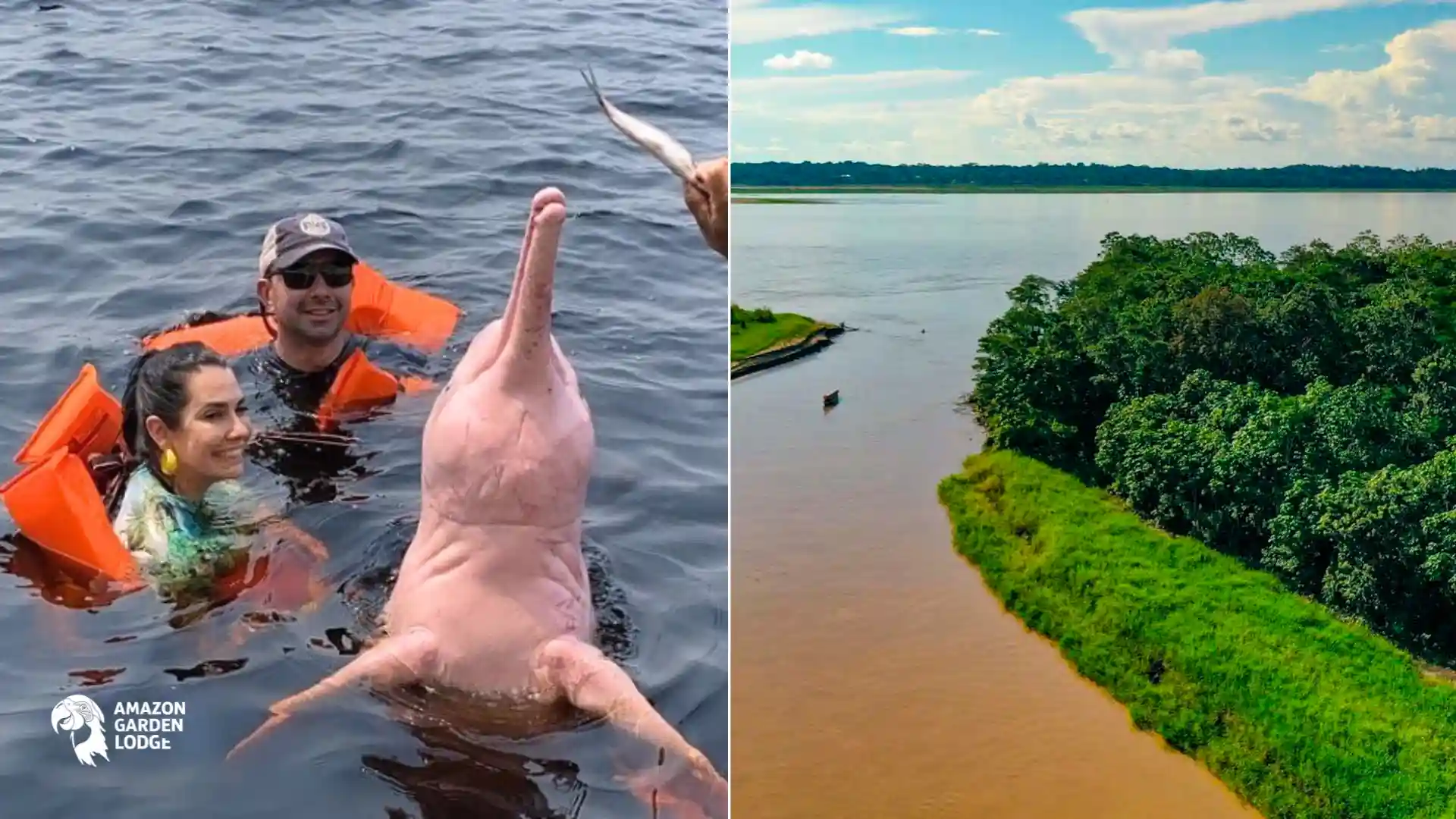
Getting to know the Pink Dolphin
The Amazon river dolphin, scientifically known as Inia geoffrensis, is the largest freshwater dolphin in the world. It inhabits the Amazon basin, especially in countries like Peru, Brazil, Colombia, Bolivia, and Ecuador. In Peru, it is commonly found in rivers such as the Amazon, Marañón, and Ucayali.
Unlike marine dolphins, the Amazon river dolphin has evolved to live in a complex environment of rivers, lagoons, and flooded forests. During the rainy season, these dolphins move among submerged trees, making them excellent navigators in confined spaces.
What makes the Amazon River Dolphin unique?
The Amazon river dolphin stands out not only for its striking pink color but also for its unusual physical and behavioral traits. Unlike ocean dolphins, it has a flexible neck, allowing it to move its head side to side, which is ideal for navigating through flooded forests and submerged trees during the wet season.
In addition, it has one of the largest brains among dolphins and displays highly developed intelligence and curiosity. It uses advanced echolocation to hunt in murky waters where visibility is extremely low, allowing it to detect prey such as fish, crustaceans, and even small turtles. In fact, its diet includes more than 50 different species of fish.
Its body is also specially adapted to river life. The Amazon river dolphin has broad pectoral fins and a long beak, helping it maneuver with precision in narrow channels and dense vegetation. Unlike marine dolphins, its dorsal fin is smaller and more ridge-like, which improves mobility in shallow waters.
Its coloration can vary from light gray to vivid pink, often becoming more intense with age. Scientists believe this pink hue may be related to blood flow, social interactions, or even minor abrasions on the skin. Interestingly, more active or older males tend to appear pinker, which may play a role in attracting mates.
You might be interested: Festivals in Cusco month by month

15 Fascinating facts about Amazon pink dolphins
The Amazon pink dolphin (Inia geoffrensis) has roamed the rivers of South America for millions of years, long before humans ever set foot in the jungle. And yet, most people know almost nothing about this extraordinary freshwater mammal. From its surprising intelligence to its shape-shifting mythology, the boto or pink dolphin is full of secrets. These 15 fascinating facts are just the beginning.
1. The boto has a superpower brain
The Amazon pink dolphin is the smartest of all five freshwater dolphin species. Its brain capacity is approximately 40% larger than that of humans, giving it remarkable problem-solving abilities, spatial memory, and complex social awareness. This intelligence is reflected in behaviors like using tools, playing with objects, and even stealing oars from fishermen’s boats.
2. It can turn its head like no other dolphin
Unlike marine dolphins, the Amazon pink dolphin has unfused neck vertebrae, which gives it the extraordinary ability to rotate its head up to 180 degrees. This adaptation allows it to navigate through flooded forests, submerged roots, and tangled vegetation with remarkable precision.
3. It uses echolocation like a built-in GPS
Because the Amazon’s waters are murky and dark, vision is nearly useless underwater. The pink dolphin evolved a highly sophisticated echolocation system, emitting between 30 and 80 clicks per second to detect prey, navigate obstacles, and communicate. The large, rounded bump on its forehead, called the melon, acts as a natural acoustic lens that focuses these sound waves.
4. It swims upside down on purpose
One of the most curious behaviors of the Amazon pink dolphin is its habit of swimming upside down near the riverbed. Scientists believe this is not random play but a deliberate hunting strategy, allowing the dolphin to scan the river floor more effectively with its downward-facing eyes while using its long snout to probe the sediment for hidden prey.
5. How big can an Amazon pink dolphin actually get?
The Amazon pink dolphin can reach impressive sizes. Adult males typically measure between 2.3 and 2.6 meters in length and can weigh up to 185 kilograms, making them significantly larger than females.
This sexual dimorphism is uncommon among dolphins, as in many marine species, females are usually the same size or even larger. In the case of the pink dolphin, the larger, pinker males often have an advantage during mating season.
6. What makes their pink color so special?
The Amazon pink dolphin’s distinctive pink color is one of its most striking features. At birth, these dolphins are gray, but over time they develop pink tones that can range from a soft light pink to an intense, almost fuchsia color.
This color change is due to several factors, including age, blood circulation, and possible skin scarring caused by interactions with other dolphins or the environment. Furthermore, it is believed that pinker males are more attractive to females, making the color a possible indicator of health and strength.
8. It gets pinker when excited
The Amazon pink dolphin’s color is not static. When the animal becomes excited, agitated, or physically active, blood flow to the skin increases and its pink tone intensifies visibly, much like a human blush. This means that during play, feeding frenzies, or social interactions, a boto can shift from pale pink to a vivid, almost rose-red color in a matter of seconds.
9. How long do pink dolphins live in the wild?
In the wild, the Amazon pink dolphin can live between 20 and 30 years, although some studies suggest they could reach longer ages under favorable conditions. However, their lifespan has been affected by threats such as river pollution, deforestation, and illegal fishing. These pressures have reduced their populations in several regions of the Amazon.
10. It is a seasonal traveler
The boto’s entire lifestyle is governed by the Amazon’s flood cycle. During the wet season, when rivers overflow and entire forests become submerged, pink dolphins venture deep into the flooded jungle, weaving between trees and following fish into areas that are dry land just months earlier. When the dry season returns, they retreat back to the main river channels, adapting their diet and social behavior accordingly.
11. Mothers are extraordinarily devoted
Amazon pink dolphin mothers carry their calves for approximately 11 months and nurse them for over a year. During this period, mothers and calves are rarely separated, often staying together in calm, flooded areas away from adult males. Young dolphins remain dependent on their mothers for up to three years, learning hunting techniques, navigation, and social behavior through direct observation.
12. What is the best time to see pink dolphins in the Amazon?
In the Peruvian Amazon, the Amazon pink dolphin can be seen year-round, especially in areas like Iquitos, the Amazon River, and the Pacaya Samiria National Reserve. However, the best time to see them is during the dry season, between June and October.
During the rainy season, which runs from November to May, the river level rises, and the dolphins disperse into flooded forests. While it is possible to see them, the probability is lower because they have a much wider area to roam and do not congregate in specific locations.
As for locations, the best places to observe them in Peru are the Pacaya Samiria National Reserve, the Amazon River near Iquitos, and the Marañón and Ucayali Rivers. These areas maintain healthy ecosystems, which favors the presence of fauna such as the pink dolphin.
13. What do Amazon pink dolphins eat?
The Amazon pink dolphin has a very varied and opportunistic diet. It feeds on more than 50 species of fish, including piranhas, catfish, and other river fish. It also consumes turtles, frogs, and freshwater crustaceans. Thanks to its specialized teeth, it can both catch and crush prey. It usually hunts alone and uses echolocation to find food in murky waters.
14. Is it legal to swim with Amazon pink dolphins?
Yes, it is legal to swim with the Amazon pink dolphin in countries like Peru and Brazil, but it comes with certain conditions. While harming or hunting these animals is strictly prohibited, there are regulations in place to protect them, especially within natural reserves and protected areas.
In some турист destinations, swimming with pink dolphins is allowed under supervision, although practices can vary depending on the location and the tour operator.
However, the ethical side of this experience is just as important. Many experts advise against activities that involve feeding, attracting, or touching the dolphins, as these actions can disrupt their natural behavior and create a dependence on humans.
15. Where does the Amazon pink dolphin live in the Amazon?
The Amazon pink dolphin inhabits the Amazon and Orinoco river basins, distributed across countries such as Peru, Brazil, Colombia, Ecuador, and Bolivia. In Peru, it is most common in areas near Iquitos, including the Amazon River, the Marañón River, the Ucayali River, and protected areas like the Pacaya Samiria National Reserve. You can find them in calm waters such as slow-moving rivers, lagoons, and flooded forests.
The Amazon pink dolphin in indigenous mythology
One of the most well-known stories is that of the “enchanted one.” According to local beliefs, the pink dolphin has the ability to transform into a human at night. It is said to appear at village gatherings or celebrations, often dressed elegantly and standing out for its charm.
In this human form, the enchanted figure is described as a talented dancer and musician who attracts attention easily. Before sunrise, it returns to the river and becomes a dolphin again. Some versions of the story even suggest that it can lure people into the water, where they disappear into its world.
Guardians of the rivers
Within Indigenous worldviews, the pink dolphin is often seen as a protector of rivers and aquatic life. It is believed to help maintain balance in the ecosystem and ensure the health of fish populations.
Because of this, harming a dolphin is considered a serious offense that could bring negative consequences. These beliefs have, in some areas, helped reduce direct harm to the species by promoting respect for its role in nature.
You might be interested: 15 Traditional food in Peru

Journey of the pink dolphins
The Amazon pink dolphin isn’t the fastest swimmer, typically moving between 8 and 13 km/h, although it can reach speeds of up to 24 km/h in short bursts. However, what truly defines its journey isn’t speed, but its extraordinary adaptability.
During the high-water season, females remain in flooded areas with their calves, such as lagoons and channels within the forest. Males, on the other hand, usually migrate to the main rivers in search of breeding opportunities. When the water level drops, they all return to deeper rivers and channels, where food is more abundant.
Unlike other dolphins, its flexible neck allows it to move its head with a wide range of motion, facilitating its movement among submerged roots and branches. This adaptation is key to surviving in an environment as complex as the Amazon. Reproduction generally occurs between May and July, coinciding with high water levels. During this period, males exhibit unique behaviors such as offering objects to females, ranging from branches to clay balls.
You might be interested: 40 Animals in the peruvian amazon

The importance of pink dolphin conservation
Saving the Amazon pink dolphin is no longer a distant concern it is an urgent one. Since being listed as endangered in 2018, its populations have continued to decline. But the boto’s disappearance would mean more than losing a beautiful animal. These dolphins are living indicators of river health: when they thrive, the ecosystem thrives. When they vanish, the whole river is in trouble.
In Peru, the threats are especially visible. Illegal mining in regions like Madre de Dios has flooded rivers with mercury, which moves silently through the food chain and accumulates in dolphins’ bodies. Unregulated fishing and nets add constant pressure, with little enforcement to stop it.
But there is reason for hope. Protected areas like the Pacaya Samiria National Reserve offer critical refuge for the species. SERNANP and local conservation organizations are working alongside riverside communities to promote sustainable tourism and environmental education building a relationship with the Amazon based on protection, not extraction.
Meet the pink river dolphins in the Peruvian Amazon
There are places in this world where nature still feels untouched, where the water is dark and still, and something extraordinary can surface at any moment. The Peruvian Amazon is one of those places, and the Amazon pink dolphin is its most iconic encounter.
Pacaya Samiria National Reserve tours (3 to 4 days, departing from Iquitos)
The Pacaya Samiria National Reserve is widely considered the best place in Peru to spot pink dolphins in the wild, protected by the Peruvian government since 1972. Most tours depart from Iquitos and include a motorboat journey along the Marañón River into the heart of the reserve, where guides navigate the Yanayacu-Pucate waterways in search of pink and gray dolphins, sloths, capybaras, and seasonal birds. Nights are spent in local community houses, with guided walks to observe the reserve’s nocturnal fauna.
Amazon River lodge tours (3 to 5 days)
Lodge-based tours along the Amazon River offer a comfortable base from which to explore surrounding rivers and lagoons by boat. These itineraries typically include dolphin watching excursions at sunrise and sunset, visits to Monkey Island, piranha fishing, and stops at indigenous Yagua communities. Many lodges are located within the Yanamono Reserve area, where pink dolphin sightings along the riverbanks are a regular highlight.
Upper Amazon river cruises (4 to 5 days)
For travelers looking for a more immersive and unhurried experience, multi-day river cruises on the Upper Amazon offer some of the most rewarding dolphin encounters available. Navigating deeper into remote tributaries far from heavy boat traffic, these expeditions reach areas where botos surface freely and frequently. Wildlife sightings beyond dolphins often include giant river otters, black caimans, macaws, and dozens of bird species.

