
If you’re planning to visit the Machu Picchu circuits but aren’t sure which one to choose or how they differ, you’re in the right place. With many years of experience exploring the citadel and guiding travelers from around the world, I can help you figure out which circuit fits your travel style best, whether you’re looking for a deeper archaeological experience, breathtaking panoramic views, or a more adventurous route. Choosing the right circuit isn’t just about the destination, but about the kind of experience you want to have. Here’s everything you need to know about the new Machu Picchu tourist circuits and how to pick the one that’s right for you.
Machu picchu circuits explained
he Machu Picchu circuits are official visitor routes established by Peru’s Ministry of Culture to regulate tourist flow inside the Inca citadel and ensure its long-term preservation. This structured system was strengthened in recent years, especially after updated regulations introduced in 2021 and further reorganized in 2024, with the goal of improving conservation and enhancing the visitor experience.
Today, entry to Machu Picchu is divided into specific circuits that determine where you can walk, which sectors you can access, and how long you are allowed to remain inside the archaeological site. Once you begin a circuit, backtracking is generally not permitted, as the routes are designed to be one-way in order to reduce congestion and protect fragile structures.
These measures are part of broader conservation efforts for Machu Picchu, which was declared a UNESCO World Heritage Site in 1983 and recognized as one of the New Seven Wonders of the World in 2007. The circuit system helps preserve the integrity of the site while allowing visitors to experience its agricultural terraces, temples, plazas, and sacred spaces in an organized and sustainable way, especially as interest continues to grow among travelers combining Machu Picchu with a Sacred Valley full day tour.
New Circuits Machu Picchu 2026
As of 2026, Machu Picchu operates under an updated circuit system designed to better protect the archaeological site while improving the visitor experience. The current structure, reorganized in 2024, divides access into three main circuits and a total of 10 official routes. Each route follows a one-way path and must be selected at the time of ticket purchase. Visitors cannot freely move between sectors, which makes choosing the correct circuit essential before entering the citadel.
You might be interested: Festivals in Cusco month by month

Machu Picchu Circuit 1 (Panoramic Circuit)
Circuit 1 is designed for travelers who want to experience Machu Picchu from above. This route follows the upper agricultural terraces that overlook the entire citadel, offering the famous panoramic views that appear in postcards and travel magazines.
From these terraces you can clearly see how the Inca city was built between two mountains and surrounded by deep jungle valleys. It’s also where visitors usually take the classic Machu Picchu photo with Huayna Picchu in the background.
Because the route stays mostly in the upper sector, it is one of the best options for travelers who enjoy photography or simply want to admire the site from a distance without navigating many narrow pathways. For visitors comparing cusco day tours, this circuit offers one of the most iconic and rewarding viewpoints in the sanctuary.
Machu Picchu + Machu Picchu Mountain (Route 1A)
Route 1A combines the panoramic circuit with the Machu Picchu Mountain hike, the highest mountain inside the sanctuary. This trail climbs to an elevation of about 3,082 meters (10,111 ft) above sea level.
The hike usually takes between 2 and 3 hours round trip, depending on pace. The path consists mostly of stone steps that climb steadily along the mountain ridge.
From the summit you get one of the widest views of the entire region: the Machu Picchu citadel below, the Urubamba River winding through the valley, and the surrounding cloud forest mountains stretching far into the Andes.
Machu Picchu Classic Photo or Upper Terrace (Route 1B)
Route 1B is the most popular option within Circuit 1 because it provides access to the famous viewpoint near the Guardian’s House.
From here you can capture the iconic photograph of Machu Picchu with the ruins perfectly framed by terraces and Huayna Picchu behind them.
This route is shorter than the mountain hikes and focuses mainly on scenic viewpoints rather than deep exploration of the city. Visitors walk along the upper terraces and observation areas before exiting the circuit.
Machu Picchu + Inti Punku (Route 1C)
Route 1C connects the panoramic terraces with Inti Punku, also known as the Sun Gate. This was the original entrance to Machu Picchu for travelers arriving along the Inca Trail.
The trail climbs gradually toward the gate, offering beautiful views of the citadel and surrounding valleys along the way. Reaching Inti Punku allows visitors to see Machu Picchu from the same viewpoint used by Inca messengers and pilgrims centuries ago.
The hike takes about 45 minutes to one hour each way and is considered moderate in difficulty.
Machu Picchu + Inca Bridge (Route 1D)
Route 1D leads to the Inca Bridge, a fascinating defensive structure built into the cliffs on the western side of Machu Picchu.
The path follows a narrow trail carved along steep mountainsides until it reaches the bridge location. In Inca times this bridge could be removed to prevent enemies from entering the city.
Although visitors cannot cross the bridge itself today, the trail provides an impressive look at Inca engineering and the dramatic landscapes surrounding the citadel.
You might be interested: 15 Traditional food in Peru
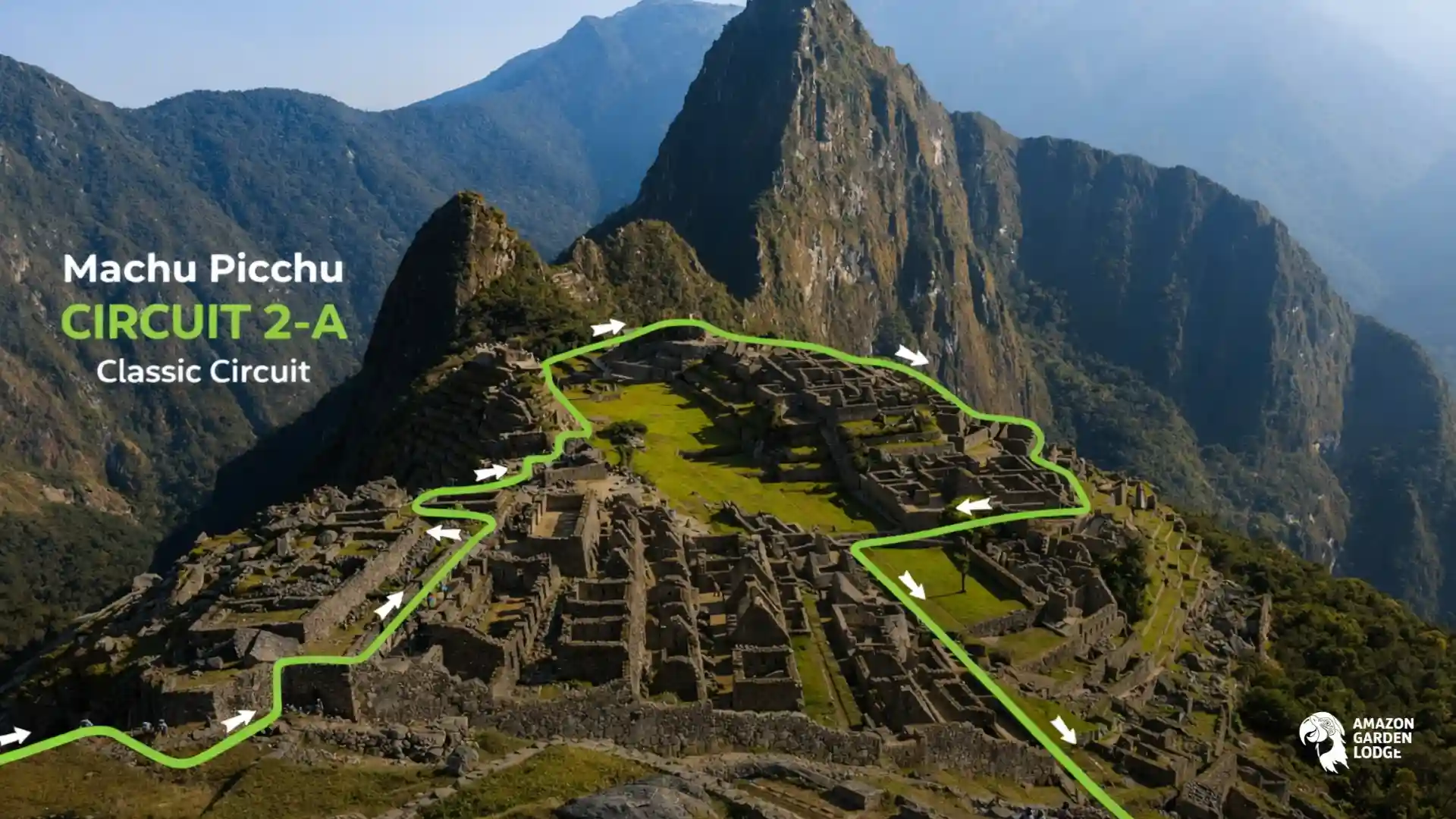
Machu Picchu Circuit 2 (Classic Circuit)
Circuit 2 is widely considered the most complete Machu Picchu tour. This route passes through the central urban sector of the citadel and includes many of the most important archaeological structures, making it a valuable option for travelers interested in history after a Cusco City tour half day.
Visitors following this circuit walk through areas that reveal how the Inca city functioned in everyday life. You can see ceremonial plazas, temples aligned with astronomical events, and residential sectors where elite families once lived.
This route includes several of the most famous landmarks in Machu Picchu, including:
- The Sacred Plaza
- The Temple of the Three Windows
- The Temple of the Sun sector
- Agricultural terraces and stone stairways
- Ancient Inca streets and drainage systems
Machu Picchu Classic Circuit (Route 2A)
Route 2A is the standard classic tour of Machu Picchu. It takes visitors through the central part of the citadel while maintaining the one-way flow designed to protect the site.
This route allows you to see the main temples, ceremonial areas, and residential structures that illustrate the sophistication of Inca urban planning. Along the way guides often explain how the Incas used advanced engineering techniques such as earthquake-resistant stone construction and complex water drainage systems.
For travelers interested in the history and architecture of Machu Picchu, this route offers the most informative experience.
Machu Picchu Lower Terrace Circuit (Route 2B)
Route 2B follows a similar path to Route 2A but begins slightly lower in the agricultural terraces. From these terraces visitors can still see the citadel from excellent angles before continuing toward the central sectors of the ruins.
This route is often chosen when tickets for Route 2A sell out, but it still provides a comprehensive visit that includes many of the most important structures.
You might be interested: 40 Animals in the peruvian amazon
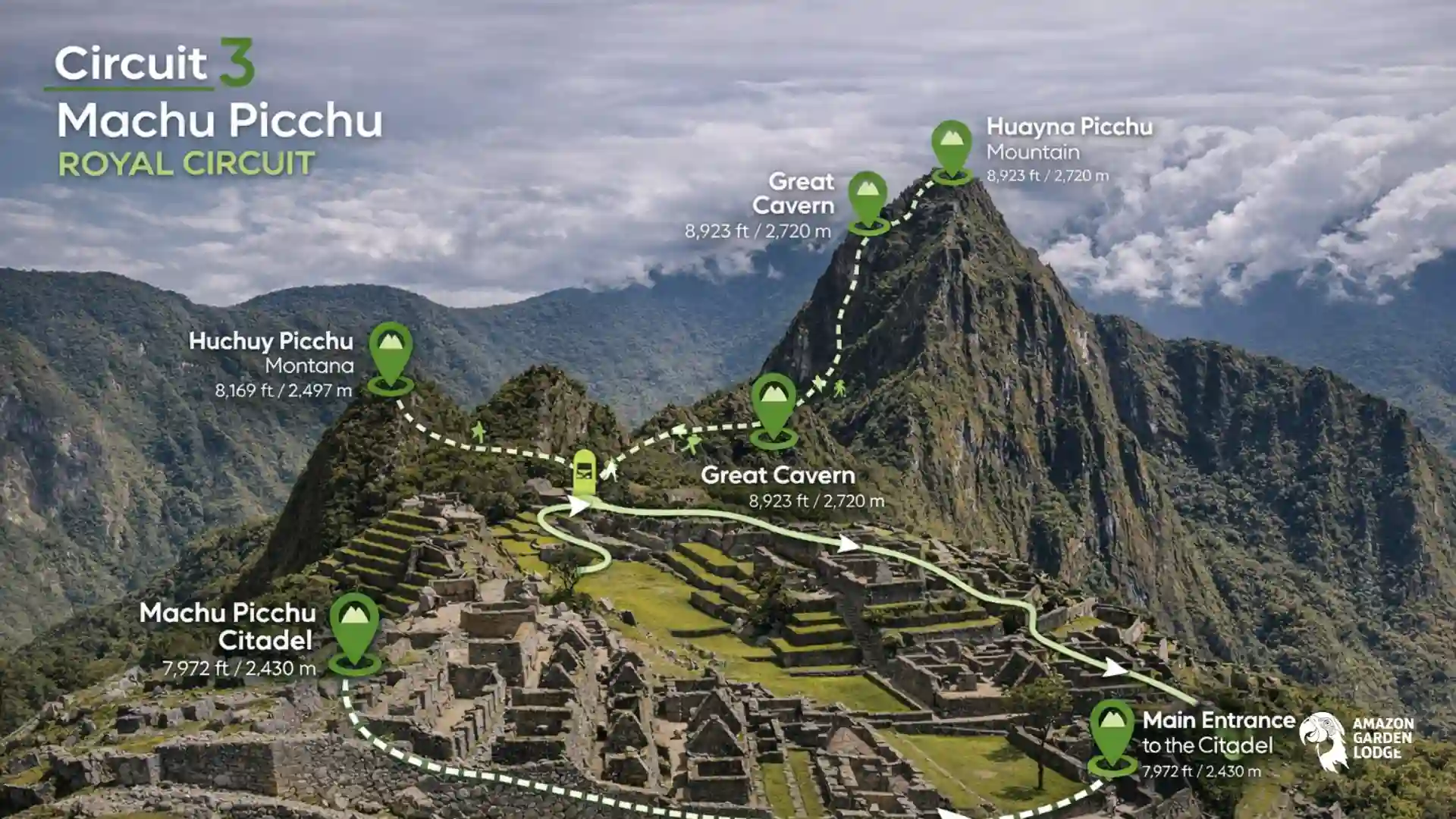
Machu Picchu Circuit 3 (Royal Circuit)
Circuit 3 focuses on the lower sector of Machu Picchu, an area many archaeologists believe was reserved for the Inca elite and ceremonial activities linked to the ruling class. Compared to the upper terraces and central plazas, this part of the citadel feels quieter and more intimate, which is why many guides describe it as the “royal sector” of the city.
This zone includes several important structures where the Incas combined natural rock formations with finely carved stone architecture. One of the best examples is the Temple of the Condor, where the shape of the surrounding rock was deliberately sculpted to resemble the wings of a condor.
Another distinctive feature of Circuit 3 is the network of water channels and fountains that still function today. The Incas designed an advanced hydraulic system that carried fresh mountain water through the city using gravity and carefully carved stone canals. Walking through this area allows visitors to see how water played an important role not only for daily life but also for ceremonial purification rituals.
Machu Picchu + Huayna Picchu Mountain (Route 3A)
Route 3A is one of the most famous Machu Picchu experiences because it includes the climb to Huayna Picchu, the steep peak that rises directly behind the citadel in the classic postcard view. This mountain stands at roughly 2,720 meters above sea level and offers one of the most dramatic perspectives of the entire archaeological complex.
The trail follows a series of narrow Inca stone stairways that wind up the mountain ridge. In some sections the steps are steep and exposed, which is why this hike is often considered one of the most thrilling short climbs in Peru. Reaching the summit usually takes about 45 minutes to one hour, depending on your pace and the number of stops along the way.
From the top, visitors can look down on the Machu Picchu citadel, the surrounding terraces, and the Urubamba River far below. Because of safety and conservation limits, only a few hundred visitors are allowed to climb Huayna Picchu each day, which makes tickets for this route some of the hardest to obtain.
Lower Part Temples or Designed Royalty (Route 3B)
Route 3B focuses on the royal and ceremonial sector located in the lower part of Machu Picchu. Unlike the mountain routes, this circuit stays within the archaeological area and allows visitors to explore several structures associated with the elite residents of the Inca city.
Walking this route reveals an entirely different perspective of Machu Picchu. You pass through areas where archaeologists believe priests, nobility, and important officials may have lived, as well as ceremonial spaces used for rituals and spiritual practices. One of the highlights in this sector is the Temple of the Condor, where natural rock formations were shaped to resemble the wings of a condor, a sacred symbol in Inca cosmology.
Although this circuit is shorter than others, it provides a closer look at the architectural details of the citadel and the relationship between natural rock formations and Inca stonework.
Machu Picchu + Temple of the Moon or Great Cavern (Route 3C)
Route 3C is one of the most adventurous options available inside the Machu Picchu sanctuary. This route includes a hike toward the Temple of the Moon, also known as the Great Cavern, located on the far side of Huayna Picchu.
The trail leads through forested mountain paths and ancient stone steps before reaching the temple complex carved into a natural cave formation. Unlike many structures in the main citadel, the Temple of the Moon is built partly underground, integrating natural rock with finely shaped stone blocks.
Researchers believe this space may have been used for important ceremonial or ritual activities, possibly linked to astronomical observations or spiritual practices. Because the hike is longer and more physically demanding than most Machu Picchu routes, it is generally recommended for travelers who enjoy trekking and want to explore beyond the main citadel.
Machu Picchu + Huchuy Picchu (Route 3D)
Route 3D includes the climb to Huchuy Picchu, a smaller mountain located next to Huayna Picchu. Although less famous, this peak offers one of the most interesting viewpoints inside the sanctuary.
The hike is shorter and less steep than the Huayna Picchu climb, making it accessible for many visitors who want a mountain experience without the intensity of the larger peak. The trail usually takes around 30 to 40 minutes to reach the summit.
You might be interested: New year traditions in Peru
Best Machu Picchu Circuits
Choosing the best Machu Picchu circuit depends on what kind of visit you want. Since the new visitor system was implemented, every ticket follows a fixed route, and you can no longer explore the citadel freely. Each circuit highlights different areas of the site, from panoramic viewpoints to the main ceremonial temples.
For most first-time visitors, Circuit 2 is usually considered the best option. This route passes through the central sector of the citadel and allows you to see many of Machu Picchu’s most important structures, including the Sacred Plaza, the Temple of the Three Windows, and the famous agricultural terraces. Because it combines archaeological landmarks with the classic postcard viewpoint, it offers the most balanced experience of the Inca city.
Circuit 1 is ideal for travelers focused on views and photography. This route stays mostly on the upper terraces and leads to the Guardian’s House viewpoint, where the iconic panoramic photo of Machu Picchu is taken. Some variations of this circuit also connect with hikes such as Machu Picchu Mountain or the Inca Bridge.
Meanwhile, Circuit 3 explores the lower sector of the citadel, an area associated with royal residences and ceremonial structures. Here visitors can see places like the Temple of the Condor and access hiking routes such as Huayna Picchu or Huchuy Picchu. This circuit is slightly shorter but offers a different perspective of the site that many travelers overlook.
Machu Picchu Circuits map
Before visiting Machu Picchu, it’s important to understand how the official circuit system works. In recent years, Peruvian authorities introduced a structured route map to protect the archaeological site while allowing visitors to explore it in an organized way. Instead of walking freely through the ruins, travelers now follow specific paths that guide them through different areas of the citadel.
The Machu Picchu circuits map shows how these routes are distributed across the sanctuary. Each circuit follows a one-way path, meaning visitors move forward through the site without returning to previous sections. This system helps reduce congestion in narrow stone pathways, protects fragile archaeological structures, and allows thousands of visitors to experience Machu Picchu every day without overwhelming the site.
Today, Machu Picchu is divided into three main circuits, each designed to highlight different parts of the ancient city. Circuit 1 focuses on the upper terraces and panoramic viewpoints, Circuit 2 explores the central archaeological sector where many of the most important temples are located, and Circuit 3 takes visitors through the lower royal sector and connects with several mountain hikes such as Huayna Picchu and Huchuy Picchu.
You might be interested: All about the Peruvian Amazon tribes

More information about the new tourist circuits in Machu Picchu
If you’re planning to visit Machu Picchu today, it’s important to understand that the experience has changed compared to a few years ago. Visitors can no longer walk freely around the citadel. The Peruvian authorities introduced a structured system of circuits and routes designed to protect the archaeological site and control visitor flow.
Instead of wandering through the ruins, every visitor now follows a predefined path. Your ticket determines exactly where you enter, the route you walk, and the main attractions you will see along the way.
This system was introduced to reduce erosion on ancient stone paths, protect fragile structures, and avoid overcrowding in key areas such as the Temple of the Sun or the Sacred Plaza. While it may sound restrictive at first, the reality is that the circuits make the visit more organized and often more enjoyable.
As a guide who has walked these paths many times, I always recommend choosing the circuit carefully before booking your ticket. Each one offers a completely different perspective of the site.
Distribution of capacity by circuit and schedule for 2026
Machu Picchu continues to operate under a strict visitor management system designed to protect the archaeological sanctuary while still allowing travelers from around the world to experience it. For 2026, the site maintains a controlled daily capacity that is distributed across the different circuits and entry schedules throughout the day.
Rather than allowing unrestricted access, visitors enter Machu Picchu during specific time slots starting at 6:00 AM and continuing until around 3:00 PM, depending on the ticket type and circuit selected. Each ticket is tied to a precise entry time, and once inside, travelers follow a one-way route assigned to their circuit.
This system spreads visitors across the archaeological park and avoids congestion in sensitive areas such as the Sacred Plaza, the Temple of the Sun, and the narrow stairways that connect the terraces.
In practical terms, the daily capacity varies depending on the season. During regular months the number of visitors is lower, while in the busiest months authorities allow a higher number of tickets to meet demand.
Regular Season
The regular season usually runs from the beginning of the year until early spring, and again toward the end of the year. During these months the number of daily visitors allowed inside the sanctuary is slightly lower.
For travelers who prefer a calmer visit, this can actually be the best time to explore Machu Picchu. The trails feel less crowded, guides have more time to explain the history of the site, and photography becomes easier without large groups passing through every viewpoint.
Another advantage is ticket availability. During regular season it is generally easier to find last-minute tickets or alternative circuits if your preferred route is already sold out.
High Season
High season normally runs from late spring through early autumn. During this period visitor demand increases significantly, especially from travelers coming from Europe and North America.
To accommodate the higher demand, the authorities temporarily increase the number of visitors allowed inside the citadel each day. This is also the time when additional route variations are available. Some mountain hikes and special circuits open during the busiest months of the year.
From a guide’s perspective, high season offers the most stable weather conditions. Clear skies are more common and the chances of seeing the famous Machu Picchu sunrise are higher.
Comparison of the Three Machu Picchu circuits
Choosing the right Machu Picchu circuit can completely change the experience of visiting the citadel. Since the introduction of the new visitor management system, travelers must follow a specific route depending on the ticket they purchase. Each circuit highlights different parts of the archaeological site, from panoramic viewpoints to ceremonial temples and mountain hikes.
| Machu Picchu Circuits | Main focus | Highlights | Ideal for |
|---|---|---|---|
| Circuit 1 (Panoramic) | Upper terraces and viewpoints | Classic Machu Picchu photo, Guardian’s House, Inca Bridge, Inti Punku | Photography and panoramic views |
| Circuit 2 (Classic) | Central archaeological sector | Sacred Plaza, Temple of the Three Windows, agricultural terraces | First-time visitors |
| Circuit 3 (Royal) | Lower royal sector and mountain hikes | Temple of the Condor, Huayna Picchu, Huchuy Picchu | Hiking and deeper exploration |
Circuit difficulty comparison
Not all Machu Picchu circuits involve the same level of walking or physical effort. While some routes follow relatively gentle paths through the terraces and temples, others include steep stone stairways or mountain hikes that require more stamina. Understanding the difficulty of each circuit helps travelers choose a route that matches their fitness level and the type of experience they want inside the citadel.
| Circuit | Walking distance | Difficulty | Approximate duration |
|---|---|---|---|
| Circuit 1 | Moderate | Easy to moderate | 2 – 3 hours |
| Circuit 2 | Moderate | Easy | 2 – 2.5 hours |
| Circuit 3 | Varies (depending on hikes) | Easy to challenging | 2 – 4 hours |
Key differences between the Machu Picchu circuits
Although all three Machu Picchu circuits allow visitors to explore the ancient Inca city, each one offers a slightly different perspective of the site. The routes were designed to highlight specific areas of the citadel while managing visitor flow and protecting fragile archaeological structures.
| Feature | Circuit 1 | Circuit 2 | Circuit 3 |
|---|---|---|---|
| Classic postcard viewpoint | Yes | Yes | Limited |
| Main temples access | Limited | Full access | Partial |
| Mountain hikes included | Machu Picchu Mountain, Inca Bridge | No mountain hikes | Huayna Picchu, Huchuy Picchu |
| Best for photography | Excellent | Very good | Good |
| Best for first visit | Good | Best choice | Alternative option |

