
Holy Week in Peru, also known as Semana Mayor, is one of the country’s most important religious and cultural celebrations. It has been commemorated since colonial times, when it was introduced by the Spanish in the 16th century, and over time it merged with Andean traditions, creating a unique expression of faith and culture.
During these days, churches fill with worshippers, bells ring to signal the start of processions, and the streets are adorned with flowers and holy candles. For many Peruvians and travelers, it’s the perfect opportunity to experience the most important religious gathering in South America. In this guide, we’ll tell you everything you need to know about Semana Mayor.
You might be interested: Festivals in Cusco month by month

When is Holy Week in Peru?
Holy Week in Peru is celebrated during the week leading up to Easter Sunday. The exact dates change every year because they follow the Catholic liturgical calendar, which is based on the first full moon after the spring equinox.
This year, in 2026, Semana Santa begins on Sunday, March 29 (Palm Sunday) and concludes on Sunday, April 5 (Easter Sunday). The main national holidays are Holy Thursday (April 2) and Good Friday (April 3), when religious celebrations and processions take place throughout the country.
In Peru, the official holidays are Holy Thursday (April 2) and Good Friday (April 3). During that week, cities like Ayacucho, Cusco Lima, and Arequipa organize processions, masses, and cultural activities that attract both worshippers and tourists.
History of Holy Week in Peru
Holy Week in Peru dates back to the 16th century, when Spanish missionaries introduced Catholic traditions during the colonial period. As part of the evangelization process, religious ceremonies, processions, and reenactments of the Passion of Christ became central to spiritual life in the Viceroyalty of Peru.
Over time, Indigenous communities embraced these practices and blended them with their own Andean beliefs and symbolism. This fusion created a unique religious expression that still defines the celebration today. More than 400 years later, it remains a powerful tradition that combines faith, history, and cultural identity.
You might be interested: 15 Traditional food in Peru

Peru Holy Week calendar 2026
Palm Sunday: March 29
Holy Week in Peru begins with Palm Sunday, which commemorates Jesus’ entry into Jerusalem. In Peru, churches hold special masses where worshippers carry woven palm branches that are blessed by priests. In cities like Ayacucho and Cusco, this day marks the beginning of major public processions.
Holy Monday and Holy Tuesday: March 30–31
During these days, parishes organize evening masses and smaller processions. In some regions, sacred images are moved between churches, and devotional activities intensify as communities prepare for the most solemn days of the week.
Holy Wednesday: April 1
Holy Wednesday often features important traditional processions. In Cusco, for example, this is when the Señor de los Temblores is honored in a massive procession through the Plaza de Armas, gathering thousands of faithful participants.
Holy Thursday: April 2
Holy Thursday is a national holiday in Peru. It commemorates the Last Supper. Churches reenact the washing of the feet ritual and remain open late for visits to different altars, a tradition known as “visiting the seven churches.” Families often travel on this day, beginning the long holiday weekend.
Good Friday: April 3
Good Friday is one of the most solemn days and also a national holiday. It commemorates the crucifixion of Jesus. Many cities hold dramatic reenactments of the Passion of Christ, and large processions take place, especially in Ayacucho. Traditionally, many Peruvians avoid eating red meat on this day.
Holy Saturday: April 4
Holy Saturday is a day of reflection and anticipation. Churches hold the Easter Vigil at night, symbolizing the transition from darkness to light. Candles are lit to represent the resurrection.
Easter Sunday: April 5
Holy Week in Peru concludes with Easter Sunday, celebrating the resurrection of Jesus. In cities like Ayacucho, early morning processions and fireworks mark the joyful end of the week. Families gather to share meals, and the atmosphere shifts from solemn reflection to celebration.
You might be interested: 40 Animals in the peruvian amazon
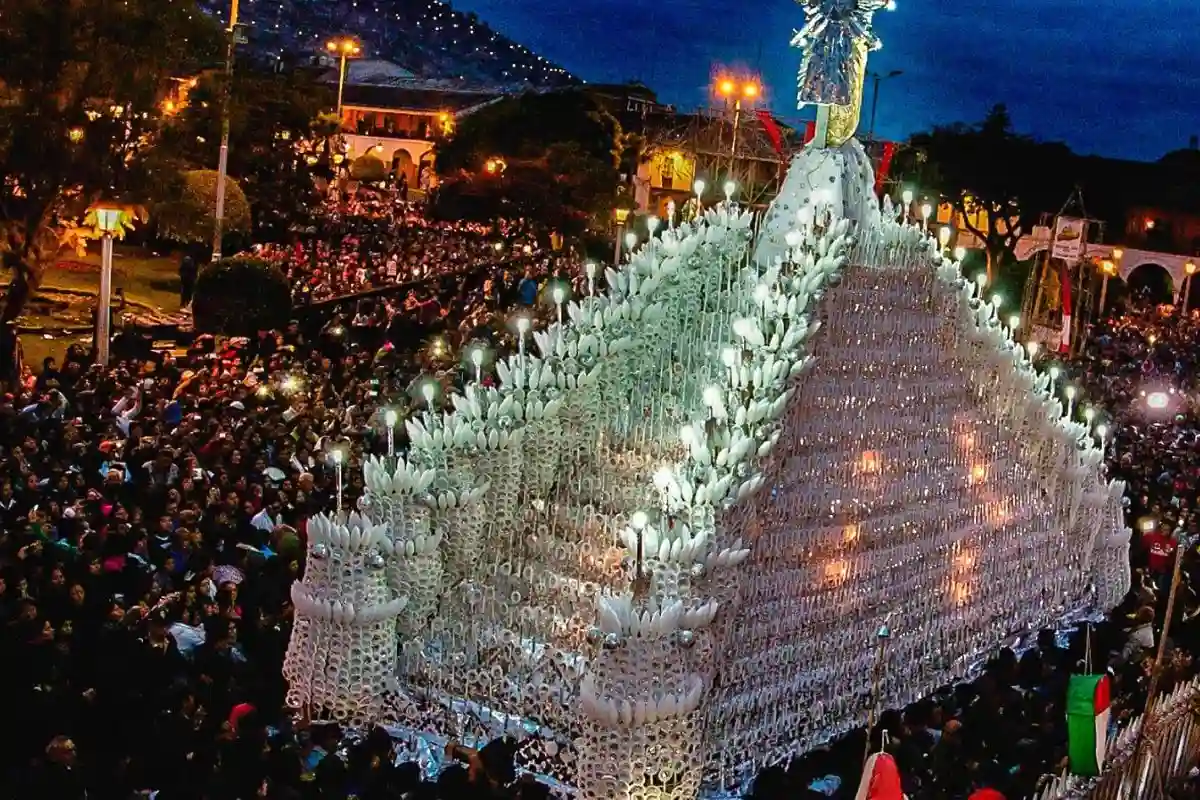
Holy Week in Ayacucho
Holy Week in Ayacucho
No city in Latin America celebrates Holy Week with the same intensity as Ayacucho. With 33 colonial churches and more than 10 processions spread across 9 consecutive days, the city of Huamanga transforms entirely from the Friday of Sorrows on April 11 through Easter Sunday.
The most singular event of the week is the Wednesday of the Encounter, a dramatic re-enactment in which the Virgin Mary, Saint John and Veronica meet Jesus on his path to Calvary. Ahead of each procession, residents spend hours laying intricate flower carpets across the cobblestones, a living art form that disappears beneath the floats and the faithful before being renewed for the next day.
The closing ceremony is equally spectacular.
During Holy Week in Peru, Easter Sunday begins before dawn with church bells and fireworks, followed by the Procession of the Lord of the Aurora. By afternoon, the legendary Morochucos horsemen gallop through the streets in a traditional race that has no equivalent anywhere else in the country, bringing this unique celebration to a vibrant close.
You might be interested: New year traditions in Peru

Holy Week in Cusco
Holy Week in Cusco
Cusco’s Holy Week stands apart because it weaves Andean spiritual traditions into Catholic ritual in ways found nowhere else on earth. The most important procession does not happen on Good Friday, as in most of the world, but on Holy Monday, when the Lord of the Earthquakes, the Sworn Patron of Cusco, is carried through the city’s streets.
As the float passes, devotees shower the image with ñucchu petals, a bright red flower harvested at altitudes above 3,500 meters and associated with the blood of Christ. The image itself is considered priceless and is insured for an extraordinary sum reflecting its historical and spiritual significance.
On Good Friday, the Via Crucis winds from Plaza San Francisco up to the Cross of the Pope at Sacsayhuamán, a climb that takes on particular meaning given the Inca stonework surrounding the procession route. That same week, the Hampi Rantikuy, a market of medicinal plants, fills the plaza according to the belief that any plant gathered during Semana Santa carries a special blessing.
You might be interested: All about the Peruvian Amazon tribes

Holy Week in Cajamarca
Holy Week in Cajamarca
Cajamarca celebrates Holy Week on a more intimate scale, with a devotion rooted in rural Andean life rather than grand urban spectacle. The most distinctive event takes place not in the city itself but in the hamlet of Porcón, just ten minutes away, where a procession of crosses decorated with mirrors winds through the lanes. According to local belief, the mirrors reflect the souls of the faithful, a tradition with no parallel elsewhere in Peru.
During Holy Week in Peru, back in the city, residents create elaborate flower carpets for the Holy Saturday procession of the Holy Sepulcher, accompanied by traditional music and dance that give the celebration a festive and communal warmth.
The food is just as memorable as the ritual. Guinea pig roasted with aromatic herbs is a Semana Santa staple, alongside artisan cheeses and the region’s famous manjar blanco. Outside the religious calendar, visitors can explore the pre-Inca necropolis of Ventanillas de Otuzco, soak in the thermal baths of Baños del Inca and walk the colonial Plaza de Armas where Francisco Pizarro’s capture of Atahualpa changed the course of history.
You might be interested: Summer in Peru: 5 top destinations to visit
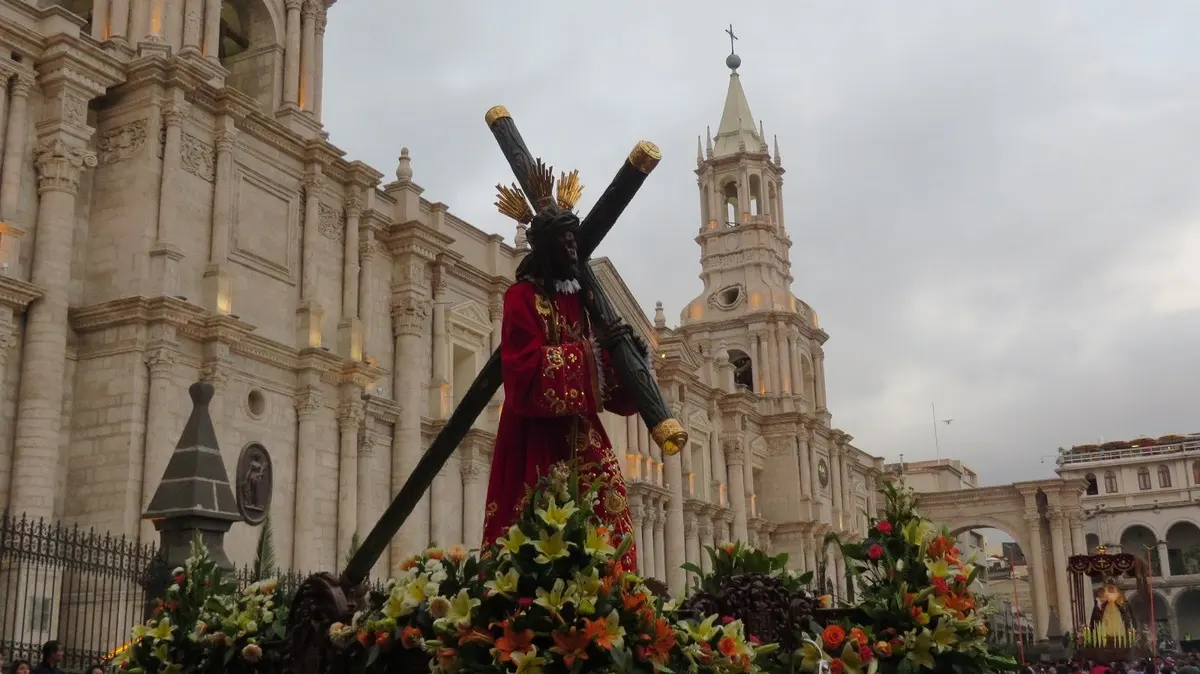
Holy Week in Arequipa
Holy Week in Arequipa
Arequipa marks Holy Week with a gravity and restraint that sets it apart from the more exuberant celebrations in Ayacucho or Cusco. The city’s churches and convents, built from the pale sillar volcanic stone that gives Arequipa its nickname, provide a dramatic backdrop for processions that move in near silence through the streets of the historic center.
The most distinctive moment comes at the close of the week, when the Burning of Judas takes place in front of the cathedral, a vivid symbolic finale that draws large crowds and carries more weight in Arequipa than in almost any other Peruvian city. Throughout the week, many families build home altars adorned with white candles, flowers and religious images, a practice recognized as part of the city’s spiritual heritage.
The rest of the visit rewards exploration of the Monastery of Santa Catalina, the Andean Sanctuaries Museum where the Juanita mummy is displayed, and the city’s legendary picanterías serving rocoto relleno and ocopa.
Holy Week in Lima
Lima’s Holy Week is more accessible than the others but no less sincere. The colonial churches of the historic center become the stage for a week of processions and pilgrimages that draw thousands of residents from across the metropolitan area.
The defining ritual is the pilgrimage to 7 churches on Holy Thursday, a tradition that sends crowds through the old jirones of downtown Lima as the faithful move from one colonial church to the next in prayer. Many carry the braided palm frond blessed on Palm Sunday, a way of keeping the symbol alive through the final days of Lent. That same Sunday, the Lord of the Triumph departs from the Monastery of Las Nazarenas at midday, accompanied by worshippers waving their palms along the route.
During Holy Week in Peru, Lima also offers some of the best gastronomy in the country. Restaurants across Miraflores and Barranco serve elaborate Lenten menus built around shrimp chowder, sea bass stew, and other dishes tied to the Catholic tradition of abstaining from meat.
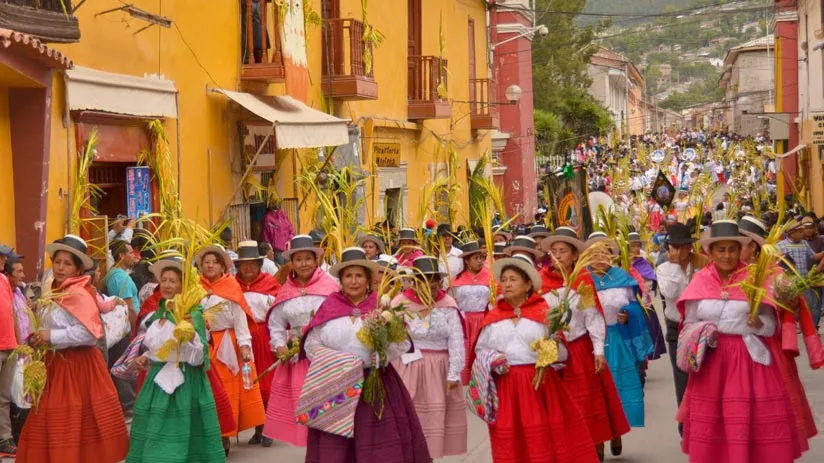
Holy Week traditions in Peru
Holy Week in Peru is not only about processions and church ceremonies. It is a time filled with symbolic customs, family gatherings, special foods, and deeply rooted practices that have been passed down for generations. Below are some of the most important traditions observed throughout the country.
Gastronomy: the tradition of the 12 dishes
One of the most important traditions in Peru is the preparation of 12 traditional dishes on Good Friday, symbolizing the 12 apostles. Families gather to share meals that usually avoid red meat and focus on fish, seafood, grains, and desserts.
Typical dishes include fish stews, lentils, rice, stuffed peppers, sweet empanadas, and traditional soups. In Trujillo, for example, the famous sopa teóloga is especially popular during this season. Desserts also play a key role, with sweets made from squash, figs, or rice pudding commonly served.
Fasting and abstinence
On Good Friday, many Peruvians practice abstinence from red meat as a sign of respect and reflection. Some also observe fasting, particularly older generations who maintain stricter Catholic customs. Fish becomes the main protein of the day, especially along the coast.
Visiting the seven churches
On Holy Thursday, it is traditional to visit seven different churches, symbolizing the path Jesus took after being arrested. Families and groups walk from church to church, praying and reflecting at each stop. This tradition remains strong in historic city centers.
Processions and religious brotherhoods
Processions are central to Holy Week in Peru, in the religious brotherhoods carry sacred images through the streets, often accompanied by brass bands, incense, and candlelight. Participants dress in traditional robes, and communities decorate streets with flowers and carpets made of colored sawdust or petals.
Easter Sunday: celebration and reunion
After days of solemn reflection, Easter Sunday marks a joyful shift. Churches celebrate the resurrection of Christ with festive masses, bells, and music. Families gather for special meals, and unlike Good Friday, meat consumption resumes as part of the celebration.

Tips for traveling to Semana Santa in Peru
Traveling during Holy Week in Peru can be an unforgettable experience, but it also requires good planning. Since Holy Thursday and Good Friday are national holidays, this period marks one of the first peak travel seasons of the year.
Book in advance
Flights, buses, hotels, and tours often sell out weeks in advance, especially in destinations like Ayacucho, Cusco, and Lima. Machu Picchu tickets in particular can become limited quickly. Prices for accommodation and transportation usually increase due to high demand, so early reservations help secure better rates and availability.
Expect heavy crowds
Historic centers, main squares, and churches can become extremely crowded, particularly on Holy Thursday and Good Friday. Arriving early is essential if you want a good spot to watch a procession. Keep personal belongings secure in busy areas, as pickpocketing can occur in large gatherings.
Safety and street closures
During major processions, streets are frequently closed and traffic is rerouted. Taxis and public transportation may take longer than usual. Plan extra time for transfers and confirm pickup points with your Peru tour operator, as access to certain hotels may be temporarily restricted.
Visiting churches
Churches are open to the public, but capacity can be limited during key ceremonies. Be prepared to wait in line. Dress modestly, avoid flash photography, and remain quiet during services. On Holy Thursday, many locals visit seven churches, so expect especially high foot traffic in city centers.
Respect local customs
For many Peruvians, Semana Santa is a sacred time of reflection. On Good Friday, it is traditional to avoid eating red meat, and some restaurants offer special fish based menus. Being respectful during processions, not blocking participants for photos, and maintaining appropriate behavior will ensure a positive experience.

