

The Q’eswachaka Bridge Festival is one of the most extraordinary structures in the Andes. Today you will learn about an ancient ritual where Quechua communities from four villages gather every June to reconstruct an Inca rope bridge by hand, using the same techniques their ancestors mastered more than 600 years ago. Each year, hundreds of villagers braid ichu grass into thick, woven cables, working together for four days in a ceremony filled with offerings and gratitude to Pachamama.
In this article we’ll tell you about the history of the Qeswachaka bridge, how you can visit it, and everything you need to know to experience this unique place in Cusco.
What is Qeswachaka, the Last Inca Bridge?
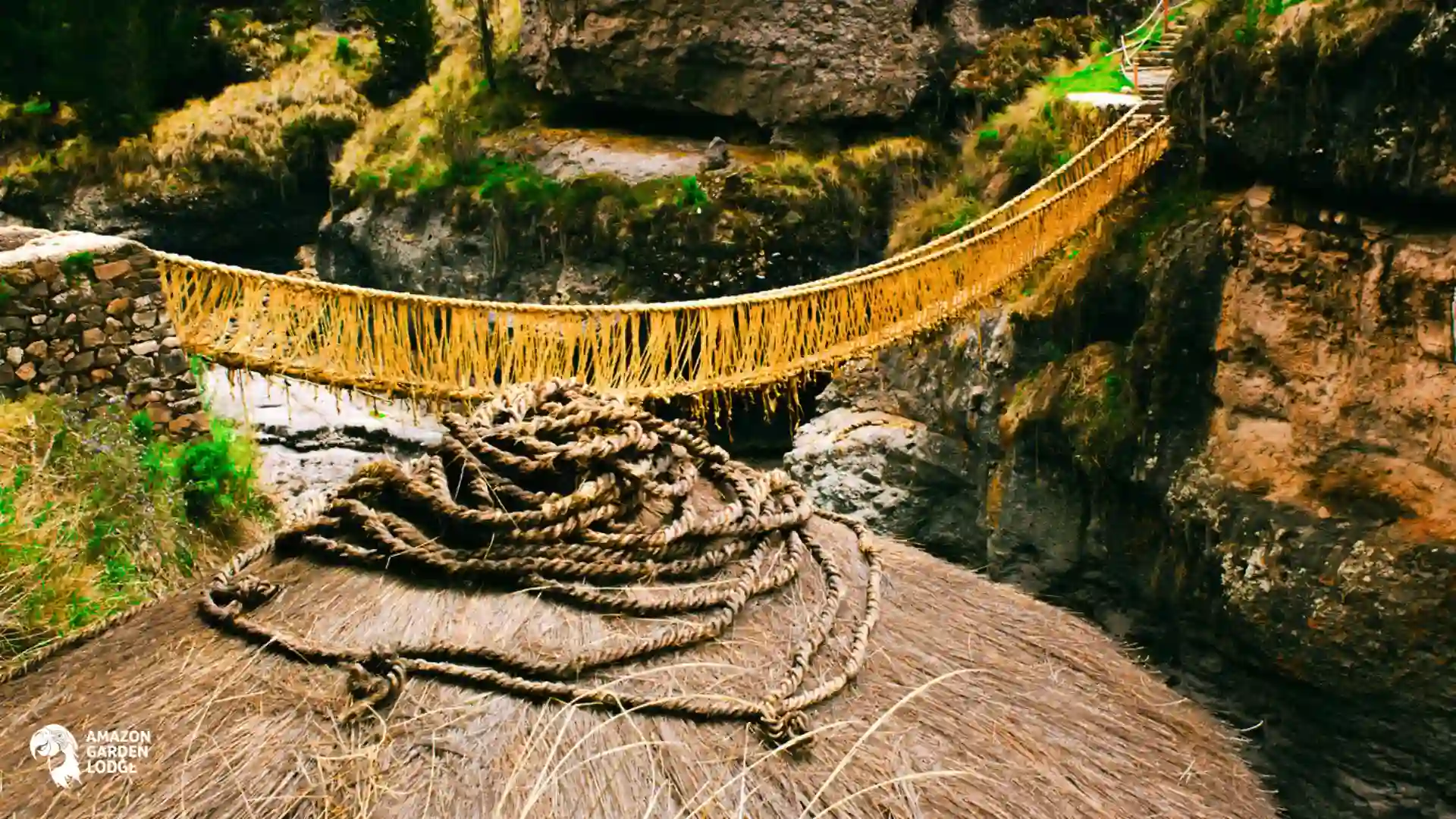
The Q’eswachaka bridge is a handwoven rope bridge spanning the Apurímac River in the Cusco region of Peru, considered the last surviving example of the Inca suspension bridge network that once connected the entire Tawantinsuyu empire. It stretches approximately 28 meters long and hangs about 8 meters above the river, woven entirely from ichu grass, a native Andean plant that grows abundantly in the surrounding highlands.
For the Inca, rope bridges like Q’eswachaka were critical infrastructure, maintained by local communities as part of the mit’a system, a form of collective labor that sustained the empire. What makes Qeswachaka exceptional is that this tradition never stopped. The four Quechua communities of Huinchiri, Chaupibanda, Ccollana Quehue, and Qhapaq Ñan have rebuilt it every June for over 600 years, passing the knowledge from generation to generation without interruption.
What does “Q’eswachaka” mean?
The name Q’eswachaka comes from the Quechua language and translates directly as “rope bridge,” where q’eswa means rope or twisted fiber and chaka means bridge. Simple in its literal meaning, yet deeply loaded in context, the name captures the essence of what this structure has always been: a connection woven by human hands between two sides of an impossible divide.
The bridge crosses the Apurímac River, whose own name carries equal weight in Quechua. Apurímac means “the god who talks,” a reference to the powerful roar of the river as it surges through the canyon below. For Andean communities, this was not mere poetry but a spiritual reality: the river was a living deity, and crossing it required more than engineering. It required ceremony, intention and respect.
You might be interested: Festivals in Cusco month by month
What was the Inca Bridge made of?
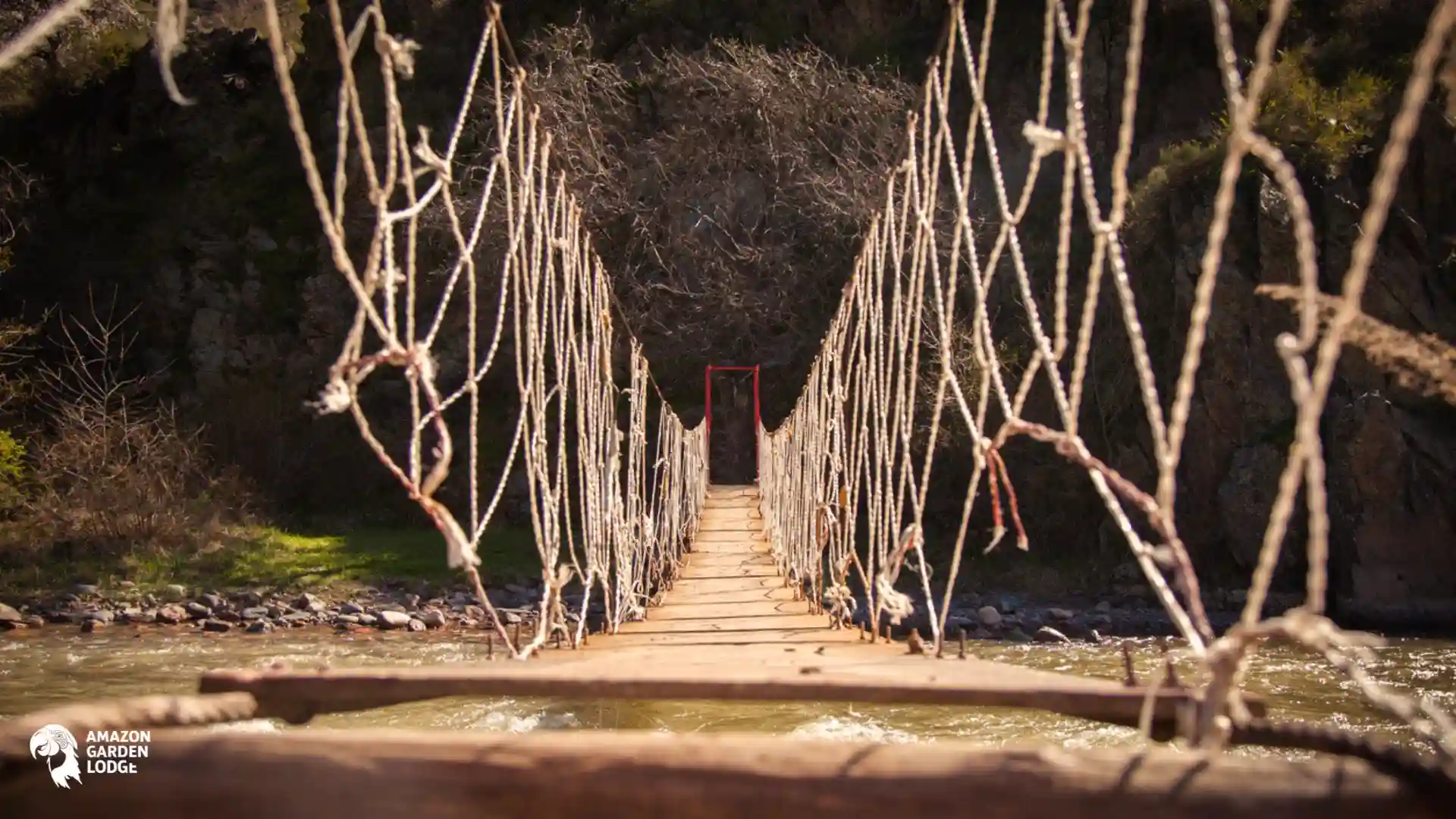
The Inca bridge, the famous Q’eswachaka Bridge in Cusco, Peru was made mainly from ichu grass. This is an Andean grass that people also call q’oya. The people who made the Qeswachaka Bridge chose this grass because it is light and it can withstand a lot. It is also easy to find this grass in the highlands.
To build the Q’eswachaka Bridge people from communities went out and collected the ichu grass. They dried the ichu grass. Then they softened it. After that they twisted the ichu grass into ropes. These small ropes were then braided together to make stronger cables. The biggest cables were used to make the base of the bridge. The other ropes were used to make handrails and side supports. This is really impressive because it shows that the Incas were very good at engineering and they knew a lot about nature.
Every year, the bridge is fixed by four communities: Huinchiri, Chaupibanda, Choccayhua and Ccollana Quehue. These communities are all Quechua communities, and visiting this site can be a great cultural complement after a Cusco City tour half day, especially for travelers who want to understand more about Inca engineering and living Andean traditions.
You might be interested: 15 Traditional food in Peru

The History of Inca Rope Bridge
Inca rope bridges were a vital part of the Qhapaq Ñan, the vast royal road network that connected over 30,000 kilometers across South America, linking coastal deserts, highland valleys and Amazon rainforest under a single empire. At its peak, the Inca empire maintained hundreds of these suspension bridges, allowing armies, messengers known as chasquis, and traders to cross rivers and deep canyons that would have otherwise been impassable.
These bridges were not built from stone or wood but from ichu grass, twisted and braided into thick cables strong enough to support the weight of llama caravans and entire battalions. Spanish chroniclers who arrived in the 16th century were astonished by their engineering, with some describing bridges stretching over 60 meters that swayed gently above terrifying drops yet held firm under heavy loads.
Q eswachaka Festival: The Inca bridge
The Qeswachaka Festival takes place every year in June, typically during the second week of the month, and lasts four days. While the exact dates shift slightly each year, it usually falls around June 8 to 11, when the ichu grass is dry and ready to be harvested and the Andean winter skies are clear enough to work under.
How the Festival is Celebrated
What happens at Q’eswachaka Bridge is hard to describe without sounding like you are exaggerating. Close to a thousand people, almost all of them locals, gather in the small town of Quehue in the Cusco region for four days of collective work, ceremony and celebration. Around 700 men and women from the communities of Huinchiri, Ccollana, Chaupibanda and Qhapaq Ñan arrive with bundles of ichu grass on their backs, ready to do what their families have done for over six centuries.
The work begins before sunrise. Women and children twist the grass into thin cords while the men braid those cords into the thick main cables that will eventually support the entire bridge. It is loud, physical and deeply communal, with everyone working side by side regardless of age. By the final day the old bridge is cut loose and dropped into the river as an offering, and the new one is pulled into place and secured to stone anchors on each bank.
But the festival is not only about construction. Between working hours, the communities share food, chicha and music, and traditional dances fill the evenings. Honoring their Inca ancestors runs through every part of it, from the offerings made to Pachamama at the start to the moment the first person crosses the finished bridge. It is equal parts engineering feat, spiritual ritual and community celebration, and there is nothing else quite like it anywhere in the world. Travelers who enjoy cultural routes in Cusco can also combine this type of experience with an atv quad biking tour in nearby Andean landscapes for a more adventurous side of the region.
Day 1: Harvesting the Grass
Before dawn, community members head to the hillsides to cut ichu grass. The work opens with offerings and prayers to Pachamama asking for permission, and by midday the riverbanks are covered in bundles of raw material carried down on people’s backs.
Day 2: Weaving the Cables
Women and children twist the ichu into thin cords by hand while the men braid them into the thick main cables that will hold the bridge. It is a skill nobody ever wrote down, passed from family to family over centuries, and the sound of weaving fills the air all day alongside chicha and conversation.
Day 3: Building the Bridge
The old bridge is cut loose and dropped into the Apurímac as an offering, then the new cables are pulled across the canyon and secured to the same Inca stone anchors that have held every bridge before it. The handrails and walking surface are woven in and the structure slowly takes shape above the river.
Day 4: Celebration and First Crossing
The bridge master, known as the chakaruwaq, is the first to cross. After that, the four communities spend the day together with music, dancing and traditional food, marking another year of keeping something alive that most of the world has long forgotten.
You might be interested: 40 Animals in the peruvian amazon

How to Get to Q’eswachaka
The bridge is located in the district of Quehue, in the Canas province of the Cusco region, about 120 kilometers south of Cusco city. The journey takes roughly three to four hours by road depending on conditions.
From Cusco, the most common route is to take the highway toward Sicuani and then turn off toward Yanaoca and Quehue. The road is mostly paved until Yanaoca and turns to dirt for the final stretch down to the bridge. A 4×4 vehicle is recommended for that last section, especially during the rainy season between November and March.
Most visitors reach Q’eswachaka Bridge as part of an organized tour from Cusco, which is by far the easiest option. Agencies can handle all the logistics, including transport, a local guide and the permits needed to visit the site. Going with a local operator also means you get the full context of what you are seeing, which makes a real difference in a place where the history runs this deep.
Travel tips for Visiting Qeswachaka
The best time to visit is June, during the festival itself, when you can witness the full four-day renewal ceremony. Outside of June the bridge is still there and open to visit year-round, but the experience is quieter and more personal. Avoid the rainy season between November and March if possible, as the dirt roads leading to the site can become difficult to navigate.
What to wear and bring
The site sits at around 3,700 meters above sea level, so warm layers are essential even in the dry season as temperatures drop quickly, especially in the morning and late afternoon. Bring sunscreen and a hat since the Andean sun at that altitude is stronger than it looks. Comfortable walking shoes are a must as the terrain around the bridge is uneven and the path down to the canyon can be steep.
Altitude
If you are coming directly from sea level, give yourself at least two days in Cusco to acclimatize before making the trip. Soroche, or altitude sickness, is real and can affect even experienced travelers. Coca tea and staying hydrated help considerably.

Qeswachaka Inca Bridge facts
The Inca bridge of Q’eswachaka, located in Cusco, Peru, is a UNESCO Intangible Cultural Heritage of Humanity (recognized in 2013) for maintaining the pre-Hispanic tradition of its annual renewal with ichu grass. It has also received the “Global Award for Sustainable Architecture” from the Locus Foundation in recognition of its value as a living example of sustainable ancestral architecture.
The bridge is 28 meters long and 1.20 meters wide, suspended approximately 30 meters above the Apurímac River, at 3,700 meters above sea level in the district of Quehue, province of Canas, Cusco region.
At the height of the Inca Empire, there were nearly 200 suspension bridges woven from ichu grass and other natural materials in the Andes. Today, only one remains: Q’eswachaka. It was anchored to stone foundations at both ends of the canyon since Inca times, and its braided ichu cables offered both strength and flexibility. Suspension bridges were preferred precisely because they could withstand seismic activity that would destroy rigid structures.
All of these bridges were part of the Qhapaq Ñan, a 40,000-kilometer road network that connected the entire Inca Empire. Q’eswachaka was destroyed during the Spanish conquest to halt Pizarro’s advance toward Cusco, and was later rebuilt by local communities. The penalty for damaging an Inca bridge was death, reflecting how vital these structures were to the empire’s survival.
Ichu grass fibers last only one season, which is why the bridge must be rebuilt every year using the ancestral system of mink’a, collective labor without individual pay where the entire community benefits equally.
Other Inca Bridges in Peru
The Inca Bridge of Checacupe is really something to see in Cusco. This bridge is made of straw that is woven together. It sits on old stones. The town of Checacupe is also well known because you can see three bridges that were built at times all in one place. There is an Inca bridge and a colonial bridge and a republican bridge. So it is a place for people who like history and culture to visit.
The Inca Bridge of Machu Picchu is another place. This bridge is not like the ones made of ropes. It is a path made of stone that is built into the side of a cliff. There are logs that go across a gap. This bridge may have been used to keep people out. If you took the logs away it would be hard to get across.
In the Sacred Valley there is the Inca Bridge of Ollantaytambo. This bridge shows how important bridges were to the Incas. The old stones that the bridge is built on are still there, near the Urubamba River. The bridge connects the site to roads that people used to travel on and to trade with each other and to talk to each other. The Inca Bridge of Ollantaytambo is an example of the Inca road system and the Inca Bridge of Checacupe is also a part of this system. The Inca bridges are really cool. People should go see them.
The last Inca bridge in Cusco awaits you
When you are in Cusco and you have a lot of time we really think you should take one day to see the Qeswachaka Bridge. This is not a normal visit to a place. The Q’eswachaka Bridge is a place where you can learn about the people who live in the Andes and how they built things a long time ago.
We hope you have a wonderful day, enjoy a safe crossing of the Inca Bridge, and always remember your journey through Cusco and the Andes.

