

Birdwatching in Peru is one of the most fascinating experiences any nature lover can have. Our South American country is renowned not only for its rich culture but also for being home to one of the greatest diversities of bird species on the planet. With more than 1,800 recorded species, Peru ranks among the world’s top birdwatching destinations.
From the arid landscapes of the Pacific coast to the heights of the Andes and the vastness of the Amazon, Peru offers a unique variety of ecosystems. This diversity allows you to observe endemic, migratory, and rare bird species all in a single trip. In addition, the development of specialized routes makes it easier to access some of the best birdwatching spots on the continent.
If you’re thinking about planning a bird-watching trip, this comprehensive guide to birding in Peru will help you discover where to go, which species to look for, and how to prepare.
You might be interested: Festivals in Cusco month by month

Why is Peru one of the best destinations for birdwatching?
Birdwatching in Peru is not simply one of the best experiences a birder can have on the planet. For many ornithologists and birders who have traveled the world with binoculars in hand, it is the best, full stop. The country holds close to 1,900 species of resident and migratory birds, accounting for roughly 10% of all bird species on Earth. That number alone is staggering, but what truly sets Peru apart is not just the count. It is the extraordinary concentration of diversity packed into a single country. In one trip of two weeks or less, you can watch desert seabirds along the Pacific coast, track condors above Andean canyons, and spot macaws at an Amazon clay lick.
A geography built for biodiversity
The secret behind Peru’s avian richness comes down to its geography. The country is divided into three major ecological zones: the coastal desert swept by the cold Humboldt Current, the Andes mountain range with peaks surpassing 6,000 meters, and the Amazon rainforest that covers more than 60% of the national territory. Each of these zones has evolved its own distinct bird communities shaped by altitude, climate, and isolation.
More than 110 species found nowhere else
Beyond sheer numbers, what gets serious birders genuinely excited about Peru is its endemism. Over 110 bird species are found exclusively within Peruvian borders, species that simply do not exist anywhere else on the planet. The northern part of the country is particularly rich in this regard. The arid valleys of the Marañón and Utcubamba rivers, along with the eastern Andean slopes, shelter some of the most sought-after birds in the world: the Marvelous Spatuletail hummingbird, the Long-whiskered Owlet, and the Royal Sunangel, among many others. For any birder building a life list, Peru is not optional. It is essential.
A destination the world has recognized
The global birding community has known about Peru for decades, but in recent years the wider travel world has caught up. In 2024, Peru won four major awards at the World Travel Awards South America, widely regarded as the Oscars of global tourism, including South America’s Leading Destination, a title the country has held for seven consecutive years since 2018. Machu Picchu was named South America’s Leading Tourist Attraction for the seventh time. These recognitions reflect something birders have long understood: Peru is not just a great place to watch birds. It is one of the greatest nature destinations on the planet, where every ecosystem feels generous and alive.
What the global big day tells us
Every year, the Cornell Lab of Ornithology organizes the Global Big Day, a 24-hour worldwide event where birders try to record as many species as possible in a single day. Peru consistently finishes in the top two countries globally, recording over 1,400 species in a single day in 2024. What makes that number even more impressive is the context: Colombia, which typically edges Peru for first place, does so with three to four times more participating birders out in the field.
Peru achieves nearly the same result with a fraction of the human effort. That speaks to something raw and fundamental about the country’s avian density, birds are simply everywhere, in every habitat, at every elevation, in numbers that reward even a casual morning walk.
Infrastructure that has grown with the demand
Two decades ago, serious birdwatching in Peru meant roughing it in conditions that not everyone was ready for. Today the experience has been transformed. Across the country’s three birding routes, Southern, Central, and Northern, a network of specialized ecolodges, expert local guides, and well-developed birding trails has matured into one of the finest nature tourism infrastructures in the Americas.
You can stay at intimate lodges deep inside Tambopata with trained ornithologists on staff, spend nights at cloud forest stations in Abra Patricia with feeders that attract rare hummingbirds to your window at dawn, or join small-group tours led by Peruvian guides who can identify 600 species by ear alone. The quality of guiding in Peru, in particular, is world-class, many of the country’s bird guides have spent their entire careers studying the forests where they work, and that depth of local knowledge is something no field guide can replicate.
A country still discovering itself
Perhaps the most extraordinary thing about birdwatching in Peru is this: the country has not even finished exploring itself yet. Two thirds of the Manu Biosphere Reserve remain completely unexplored. Scientists believe that within those uncharted forests live both uncontacted indigenous communities and bird species that have never been documented by science. In the past 30 years alone, more than 42 new bird species have been described just from some of Peru’s few protected regions.
You might be interested: 15 Traditional food in Peru

Essential tips for birdwatching in Peru
We want to make sure your time in the field is as rewarding as possible, so we are sharing the tips our expert guides rely on every single day. A little preparation goes a long way in Peru, and the difference between a good morning and a truly unforgettable one often comes down to a few simple habits that you will carry with you for every birding trip after this one.
The best times to go out
If there is one piece of advice every specialist guide in Peru agrees on without hesitation, it is this: set your alarm early. The window between 5:30 and 9:00 AM is when the jungle and the highlands truly come alive. Birds are feeding, singing, establishing territories, and moving through the canopy in ways that simply do not happen at any other time of day. As the morning progresses, activity drops off noticeably, and by noon the forest can feel almost silent. Do not be discouraged by that midday lull though.
Use it to rest, review your notes, and plan what comes next, because the day has a second act. The late afternoon, roughly between 4:30 and 6:30 PM, is prime time for crepuscular species that become active again as the heat fades. Some of the most breathtaking sightings we have ever witnessed in Peru happen in that golden hour just before the forest goes dark.
Gear that makes a real difference
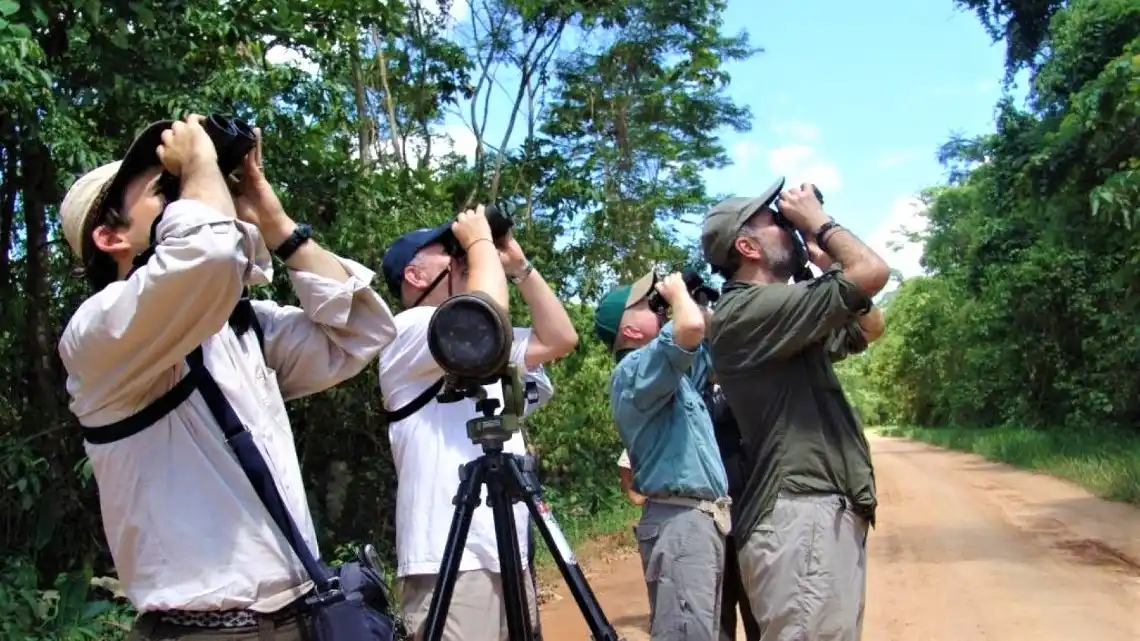
You do not need to arrive like a professional expedition photographer, but a few key items will transform your experience. A quality 8×42 binocular is non-negotiable in low-light forest conditions, and we always recommend pairing it with the Merlin Bird ID app from the Cornell Lab of Ornithology. It works offline, covers virtually every species in Peru, and its real-time sound identification feature is something that genuinely surprises first-time visitors. On the practical side, wear neutral colors like greens and beiges, bring sunscreen and insect repellent, and always carry more water than you think you need, especially at altitude where it is easy to forget to drink.
How to behave in the field
The birds of Peru are wild, and keeping them that way is part of what makes this country so extraordinary. Move slowly, speak quietly, and when you spot a perched bird, resist the urge to rush closer. Give it a moment and it will almost always reward your patience with a longer, cleaner view.
Never feed or touch the birds, stick to designated trails, and please avoid using recorded playback calls to attract species. Playing a bird’s song under false pretenses causes real stress in heavily visited areas. The best birdwatching is always the kind where the bird comes to you on its own terms, and in Peru, if you simply put yourself in the right place and wait, that happens more often than almost anywhere else on Earth.
You might be interested: 40 Animals in the peruvian amazon

Birdwatching on the Peruvian Coast
Birdwatching in Peru’s coast tends to get overlooked by birders who come with their eyes fixed firmly on the Amazon, and we understand why. But we would do you a real disservice if we let you skip it. The Peruvian coast is one of the most productive marine birding environments on the planet, powered entirely by the Humboldt Current, a deep cold-water upwelling that sweeps northward along the Pacific shore and generates one of the richest marine ecosystems anywhere on Earth.
That cold, nutrient-dense water feeds enormous schools of anchovies and sardines, and those fish in turn support seabird colonies of staggering size. What you witness from the cliffs or the boat tour here is not just birdwatching. It is a feeding frenzy of oceanic proportions.
Paracas National Reserve and the Ballestas Islands
About three and a half hours south of Lima, the Paracas National Reserve protects 827,803 acres of marine and coastal desert ecosystems, and it records 216 bird species within its boundaries, including the endangered Peruvian Diving-Petrel and the endangered Peruvian Tern. The reserve’s mud flats around Paracas Bay are a critical stopover for migratory shorebirds moving between North and South America, and during low tide in the early morning you can scan for Snowy Plover, Semipalmated Sandpiper, Ruddy Turnstone, Sanderling, and a dozen other wader species working the shoreline. The endemic Coastal Miner, one of the reserve’s key target species, can often be found near the museum area.
A boat tour to the Ballestas Islands is a must. Often called the Poor Man’s Galápagos, these volcanic islands host hundreds of thousands of seabirds in dense, noisy, utterly spectacular colonies. Guanay Cormorants, Red-legged Cormorants, Peruvian Boobies, Peruvian Pelicans, and graceful Inca Terns crowd every available rock surface. The islands are also one of the few reliable places to see the Humboldt Penguin in Peru, a vulnerable species that nests in rocky crevices just above the waterline. On the way back to port, scan the open water for pelagic species including the Markham’s Storm-Petrel and the Peruvian Diving-Petrel, two birds that serious listers specifically come to this coast to see.
Pantanos de Villa and Lima’s wetlands
Most travelers pass through Lima without a second thought for its birdlife, but the Pantanos de Villa Wildlife Refuge, just 20 minutes south of the Miraflores district, is a genuine surprise. This coastal wetland supports over 210 bird species including herons, coots, Many-colored Rush-Tyrant, and seasonal migratory visitors. It is the kind of place you can visit on an early morning before a domestic flight and still add a dozen species to your list. The Ventanilla wetlands near Callao are another underrated stop, with up to 120 species recorded in that relatively compact area.
Mangroves of Tumbes
Up in the far northwest, near the Ecuadorian border, the Tumbes mangroves represent a completely different ecosystem from the desert coast further south. These are the only true mangroves in Peru, and they shelter a distinctive community of birds including herons, kingfishers, and a suite of Tumbesian endemics found nowhere else in the country. The contrast between the dense green canopy and the surrounding coastal desert is striking, and the birding here feels like a different country altogether.
Best times and practical tips for coastal birding
The coast is productive year-round, but the period from November through March brings the peak of the austral summer migration, when shorebird numbers swell and the sea conditions around Paracas are at their calmest for boat tours. Early morning visits during low tide consistently produce the best shorebird viewing at Paracas Bay. Bring strong sun protection because the Peruvian coast is intensely bright even on overcast days, and the wind off the Pacific is constant and can be cold in the morning regardless of the season.
Coastal birdwatching list
The coast gives you a mix of seabirds, shorebirds, wetland species, and endemics that you simply cannot find in any other part of Peru. Here is what to look for across the main coastal sites.
Paracas and Ballestas Islands: Humboldt Penguin, Peruvian Pelican, Guanay Cormorant, Red-legged Cormorant, Peruvian Booby, Blue-footed Booby, Inca Tern, Peruvian Tern (endangered), Peruvian Diving-Petrel, Markham’s Storm-Petrel, Coastal Miner (endemic), Surf Cinclodes (endemic), Chilean Flamingo, Black Skimmer, American Oystercatcher, White-cheeked Pintail, Snowy Plover, Semipalmated Sandpiper, Sanderling, Ruddy Turnstone, Belcher’s Gull and Kelp Gull.
Pantanos de Villa and Lima wetlands: Many-colored Rush-Tyrant, Plumbeous Rail, Great Grebe, Pied-billed Grebe, Cinnamon Teal, Ruddy Duck, Wren-like Rushbird, Great Blue Heron, Snowy Egret, Black-crowned Night-Heron, Peruvian Thick-knee, Franklin’s Gull, and Peruvian Meadowlark along nearby fields.
Tumbes mangroves: Little Blue Heron, Tricolored Heron, Roseate Spoonbill, Bare-throated Tiger-Heron, Tumbes Hummingbird, Cinereous Finch (endemic), White-tailed Jay (endemic), Ecuadorian Ground-Dove, Pacific Parrotlet and Collared Antshrike.

Birdwatching in the Peruvian Highlands
The Andean highlands are where birdwatching in Peru becomes something else entirely. You are no longer just looking for birds in a forest. You are looking for birds at the edge of the sky, in landscapes so dramatic and vast that the act of spotting a small endemic finch against a backdrop of snow-capped peaks carries an almost otherworldly weight.
The sierra covers a breathtaking range of altitudes and habitats, from the high puna grasslands above 4,000 meters to the misty polylepis woodlands, the dry inter-Andean valleys, and the cloud forests that tumble down the eastern slopes toward the Amazon. Each of these zones has its own cast of characters, and moving between them in a single day of birding is one of the great privileges of traveling in Peru.
Colca Canyon and the Andean Condor
If there is one bird that symbolizes the Peruvian highlands for most visitors, it is the Andean Condor. With a wingspan that can reach 10 feet 10 inches and a weight of up to 33 pounds, this is the largest flying land bird on Earth, and Colca Canyon is still the most reliable place in the world to see it soaring at eye level. The canyon itself is twice as deep as the Grand Canyon, and its thermal currents lift the condors from their roost sites each morning and send them gliding past the cliff-edge viewpoints in a way that never loses its power no matter how many times you witness it.
The Cruz del Cóndor lookout is the most accessible, and from there you can realistically expect to see six to ten birds at a time during a good morning visit. In addition to condors, the canyon area holds Mountain Caracara, Andean Flicker, Giant Hummingbird, Andean Goose, and Chilean Flamingo in the nearby Salinas Lagoon, where over 20,000 Andean Flamingos gather during the rainy season between December and March.
Sacred Valley and Machu Picchu
The Sacred Valley and the broader Cusco region offer Andean birding with the added bonus of some of the most extraordinary archaeological scenery in the world. The Machu Picchu Historic Sanctuary alone records 443 bird species, including 15 Peruvian endemics, and its cloud forest corridors are home to the Inca Wren, the White-capped Dipper, Torrent Ducks along the rivers, and the Purple-backed Sunbeam in the flowering shrubs above the ruins.
Nearby, the Abra Málaga Private Conservation Area is one of the best high-altitude polylepis forest sites in Peru, protecting the threatened White-browed Tit-Spinetail and offering close encounters with multiple hummingbird species in a compact area that can be visited as a half-day addition to a Sacred Valley itinerary. The Huacarpay wetlands east of Cusco are another excellent stop, recording 140 bird species including three endemics and offering open-water views that are rare at this elevation.
Cajamarca and the northern highlands
Further north, the highlands of Cajamarca and Amazonas hold a remarkable concentration of endemic species that are essentially unknown to most travelers. The Marañón Canyon, the páramo grasslands between Celendin and Cajamarca, and the cloud forest passes of this region shelter multiple endemic finches, antpittas, chat-tyrants, and tapaculos that birders specifically plan northern Peru trips around. This is specialist territory, and the rewards are proportional to the effort.
Best times and practical tips for highland birding
The dry season from April through October is the ideal window for Andean birding. Mornings with clear skies, when the high-altitude light is sharp and the air is still, produce the best conditions both for spotting and for photography. Please do not underestimate altitude. Most of the best Andean birding sites sit between 3,000 and 4,500 meters, and spending at least 24 to 48 hours acclimatizing in Cusco or Arequipa before attempting long walks at elevation makes a real difference to how much you can actually enjoy the experience.
Carry layers because the temperature can swing 30 degrees between 7 AM and midday, and a sunny morning can become a cold, cloudy afternoon in the highlands faster than almost anywhere else on Earth.
Highland Birdwatching List
The Andes reward patience and early starts with a cast of species unlike anything found in the lowlands. Here is what to keep on your radar across the main highland zones.
Colca Canyon and Salinas Lagoon: Andean Condor, Andean Flamingo (vulnerable), Chilean Flamingo, Andean Goose, Giant Hummingbird, Mountain Caracara, Andean Flicker, Black-chested Buzzard-Eagle, American Kestrel, Puna Ibis, Andean Lapwing, Andean Swallow and Torrent Duck in the canyon rivers.
Sacred Valley, Abra Málaga and Machu Picchu: Inca Wren (endemic), White-browed Tit-Spinetail (endemic), Andean Motmot, Torrent Duck, White-capped Dipper, Purple-backed Sunbeam, Sword-billed Hummingbird, Andean Condor, Creamy-crested Spinetail (endemic), Puna Ground-Tyrant, Rusty-fronted Canastero (endemic), Bearded Mountaineer and Cuzco Brush-Finch.
Huascarán and central Andes: Diademed Sandpiper-Plover (rare), Puna Tinamou, White-bellied Cinclodes (endemic), Andean Hillstar, Black-breasted Hillstar, Giant Coot, Puna Teal, Andean Avocet, Many-striped Canastero and Gray-breasted Seedsnipe.
Cajamarca and northern highlands: Rufous-backed Inca-Finch (endemic), Great Inca-Finch (endemic), Gray-bellied Comet (endemic), Jelski’s Chat-Tyrant (endemic), Black-crested Tit-Tyrant, Rufous-eared Brush-Finch, Piura Chat-Tyrant (endemic), Russet-bellied Spinetail (endemic) and Black-necked Woodpecker (endemic).

Birdwatching in the Peruvian Amazon
The Amazon is what most people come to Peru for, and it is everything they imagined and then considerably more. There is simply no place on Earth where birdwatching in Peru reaches a higher intensity than in the lowland rainforest of southeastern Peru on a good week in the dry season. No other destination lets you rack up a bird list faster or with more visual impact, and that is a statement that holds up against anywhere else on the planet.
The numbers alone are staggering: Manu National Park has recorded over 1,000 species within its boundaries, Tambopata National Reserve holds close to 700, and Pacaya-Samiria in the northern Amazon adds another 500 plus. But statistics never quite capture what it actually feels like to stand at a clay lick at dawn while hundreds of macaws in six different species drop out of the forest canopy and wheel toward the mineral-rich riverbank in a chaos of color and sound that you will remember for the rest of your life.
Manu is the crown jewel. This UNESCO World Heritage Site spans an elevation range from 300 to 3,500 meters and encompasses cloud forest, transitional forest, and lowland Amazon in a single continuous protected area. The Manu Road connecting Cusco to the Amazon lowlands is one of the world’s great birding drives, with six or more days easily filled by the parade of species that change completely as you lose altitude through the different forest zones.
The two oxbow lakes inside the park, Cocha Salvador and Cocha Otorongo, offer canoe-based birding for Hoatzins, kingfishers, herons, and Giant River Otters, and the 66-foot observation tower overlooking the lake gives elevated views of the forest canopy that are a different world from ground-level trails. Two-thirds of the Manu Biosphere Reserve remains completely unexplored, and some species recorded here still have not been formally described by science.
Tambopata is the more accessible option and no less extraordinary for it. A short flight to Puerto Maldonado followed by a boat transfer puts you in the heart of the reserve within hours of landing, and the ecolodges along the Madre de Dios River are among the best-run in South America.
The Chuncho clay lick near the Tambopata Research Center is the largest macaw clay lick in the world, and watching six species of macaws simultaneously working the mineral-rich bank is one of those wildlife experiences that photographs can never quite do justice to. The reserve also holds 32 parrot species, accounting for 10% of all parrot species on Earth, and its canopy towers and trail network give access to antbirds, manakins, toucans, and the elusive Harpy Eagle in a landscape that feels genuinely wild.
In the northern Amazon, accessible only by air or multi-day river journey, the Pacaya-Samiria National Reserve is the largest protected area in Peru and one of the most pristine flooded forest ecosystems on the continent. Over 500 bird species inhabit this watery world of islands, lagoons, and seasonally flooded forest, including the endangered Wattled Curassow, the Amazonian Umbrellabird, the Great Potoo, and multiple endemic river-island species that can be found nowhere else. Amazon river cruises departing from Iquitos offer the best way to cover this vast reserve, and the multi-day format gives the kind of deep immersion in a single ecosystem that overnight lodges cannot replicate.
Best times and practical tips for Amazon birding
The dry season from May through October is when access is easiest, water levels are lower, and birds concentrate around remaining water sources in ways that make sightings dramatically more frequent. That said, the wet season from November through April brings its own rewards, with breeding plumage, increased bird activity, and the spectacular spectacle of the flooded forest in full seasonal swing. Whatever time of year you visit, hire a specialist guide. The Amazon is a place where the difference between a knowledgeable guide and a generalist one is not 10% or 20% better birding. It is the difference between identifying 80 species in a morning and identifying 250.
Amazon birdwatching list
The Amazon is where your life list grows fastest. Here is a representative selection of the species waiting for you across the three main rainforest destinations.
Manu National Park: Andean Cock-of-the-Rock (national bird), Harpy Eagle, Hoatzin, Scarlet Macaw, Blue-and-yellow Macaw, Red-and-green Macaw, Manu Antbird (endemic), Rufous-vented Tapaculo (endemic), Golden-backed Mountain-Tanager, Sunbittern, Pavonine Quetzal, Rufous-crested Coquette, White-plumed Antbird, Wire-tailed Manakin, Blue-crowned Manakin and Bluish-fronted Jacamar.
Tambopata National Reserve: Harpy Eagle, Hyacinth Macaw, Blue-and-yellow Macaw, Red-and-green Macaw, Scarlet Macaw, Chestnut-fronted Macaw, Hoatzin, Curl-crested Aracari, Black-necked Woodpecker, Peruvian Recurvebill (endemic), Rufous-fronted Antthrush (endemic), Purus Jacamar (endemic), White-cheeked Tody-Flycatcher, Wattled Curassow and 13 species of Tinamou.
Pacaya-Samiria and Iquitos: Wattled Curassow (endangered), Nocturnal Curassow, Amazonian Umbrellabird, Great Potoo, Orange-crested Manakin, Black Bushbird, Allpahuayo Antbird (endemic), Mishana Tyrannulet (endemic), Parker’s Spinetail (endemic), Zimmer’s Antbird, Bald Uakari (as wildlife bonus), Amazon River Dolphin and Collared Puffbird.
How to organize your birding trip to Peru
Planning a birdwatching trip to Peru requires more advance thought than most other nature destinations simply because the country is large, logistics vary dramatically by region, and the best sites are often remote. The good news is that Peru has one of the most developed birding tourism infrastructures in South America, and whether you prefer to travel independently or work with a specialist operator, there is a well-worn path waiting for you.
Traveling on your own
Independent birdwatching in Peru is absolutely possible for experienced birders who are comfortable navigating a foreign country with some flexibility. Lima, Paracas, the Sacred Valley, and the areas around Cusco are all manageable without a dedicated guide, and hiring a private driver opens up many Andean routes that public transportation simply cannot reach. That said, even the most seasoned independent birders we know hire local specialist guides for the Amazon and the northern cloud forests, where the density of species and the complexity of identification make local knowledge genuinely transformative.
For planning, the eBird hotspot database is your most powerful tool. It maps species by location and season and gives you realistic expectations for any given site. Pair it with the Merlin Bird ID app and the Schulenberg et al. Birds of Peru field guide, still the definitive regional reference. Book domestic flights well in advance, particularly to Puerto Maldonado and Iquitos, as they fill up quickly during the dry season peak between June and September.
Working with a specialist tour operator
For most birders, especially those visiting Peru for the first time or targeting endemic-rich regions like the northern route or Manu, a specialist birding tour operator is the single most effective investment you can make. A well-run tour eliminates every logistical friction point and places you in the field with guides who have dedicated their professional lives to the ecosystems you are visiting. The difference in species count between a well-guided tour and a self-guided attempt in a place like Manu or Abra Patricia is not marginal. It is substantial.
When evaluating operators, ask for their target species list organized by region and site. That document tells you immediately whether the company is genuinely thinking about your goals as a birder. Group size matters too, and the best experiences consistently come from tours with eight or fewer participants. Prioritize Peruvian-led companies whose guides grew up in the regions where they work. It produces better birding and keeps more of your travel budget within the communities you are visiting.

Protected areas and regulations for birdwatching in Peru
As of 2025, Peru manages 258 protected natural areas covering more than 21% of its terrestrial territory and nearly 8% of its marine territory, all administered under the SERNANP system, the National Service of Natural Protected Areas under the Ministry of the Environment. Birdwatching is permitted and actively welcomed across virtually all of these areas, but a few practical points are worth understanding before you arrive.
Entry fees are required at most national parks and reserves and must typically be paid in cash in Peruvian soles at the entrance checkpoint, since card payment infrastructure is not available at many remote sites. Tour operators generally include these fees in their packages, but confirm this in advance. Fee structures vary by site and are updated periodically, so checking the official SERNANP website before your visit is always a good idea.
Certain zones within protected areas are restricted to authorized visitors accompanied by licensed guides. This is especially relevant in Manu National Park, where the core zone is accessible only through operators with official concession agreements, and in the most remote sectors of Pacaya-Samiria. Entering restricted zones without authorization is illegal under Peruvian law and can result in fines and removal from the area.
Beyond the national system, a growing network of private reserves and community conservation areas has become home to some of the most productive birding in the country. Organizations like ECOAN, the Amazon Conservation Association, and the Neotropical Primate Research Group manage key sites in Abra Patricia and Madre de Dios that give access to endemic species simply not reachable through the national park system. Staying at lodges affiliated with these reserves, like the Owlet Lodge or the Tambopata Research Center, directly funds the conservation work that keeps those birds there.
Stay on designated trails at all times, respect seasonal closures, and note that drone use requires special permits in most national parks and is prohibited in certain protected zones entirely. Every entrance fee and every night at a responsible ecolodge is a direct contribution to the protection of these places, and Peru’s birding community has a real role to play in making sure they remain extraordinary for the generations of birders who come after us.

