
Corpus Christi in Cusco is celebrated every year on June 4th. It’s one of those times when the entire city is transformed and reveals its deepest soul. If you’re thinking of visiting Cusco, plan your trip around this festival. You won’t regret it. Declared a National Cultural Heritage, this celebration is the result of centuries of encounter between two worlds: the Catholic tradition brought by the Spanish in the 16th century and the Andean worldview that already venerated its own deities in that same sacred space.
You might be interested: Festivals in Cusco month by month
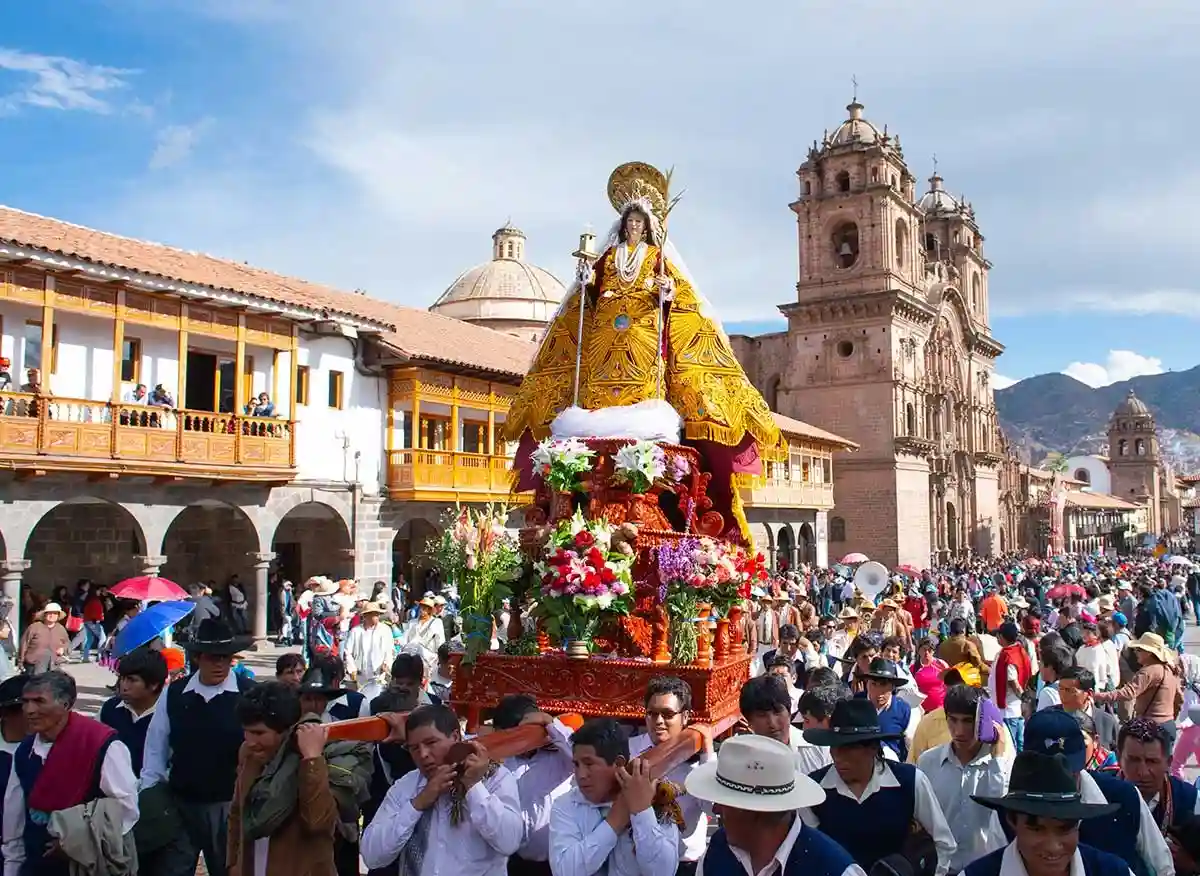
What is Corpus Christi in Cusco?
Corpus Christi is a Catholic religious celebration that commemorates the presence of Christ in the Eucharist. However, in Cusco, it takes on a much deeper and more complex meaning rooted in history.
After the Spanish conquest in the 16th century, Catholic traditions were introduced and often superimposed on existing Andean beliefs. Before colonization, the Incas held important ceremonies in sacred spaces such as Huacaypata (today’s Plaza de Armas), where they honored their own deities and natural forces.
Rather than disappearing, these ancestral traditions blended with Catholic practices. Over time, this cultural fusion gave rise to a unique form of celebration. In Cusco’s Corpus Christi, Catholic saints symbolically take on roles similar to pre-Hispanic protective deities, each representing and safeguarding specific communities or neighborhoods.
You might be interested: 15 Traditional food in Peru
When is Corpus Christi celebrated in Cusco?
Corpus Christi does not have a fixed date, as it follows the Catholic liturgical calendar. It is celebrated 60 days after Easter Sunday, always on a Thursday. This means the exact date changes every year, typically falling between late May and mid-June.
For example, in 2026, Corpus Christi will take place on Thursday, June 4. However, what many travelers don’t realize is that this is not just a one-day event. In Cusco, Corpus Christi unfolds over approximately 10 days, making it one of the longest and most immersive religious celebrations in Peru.
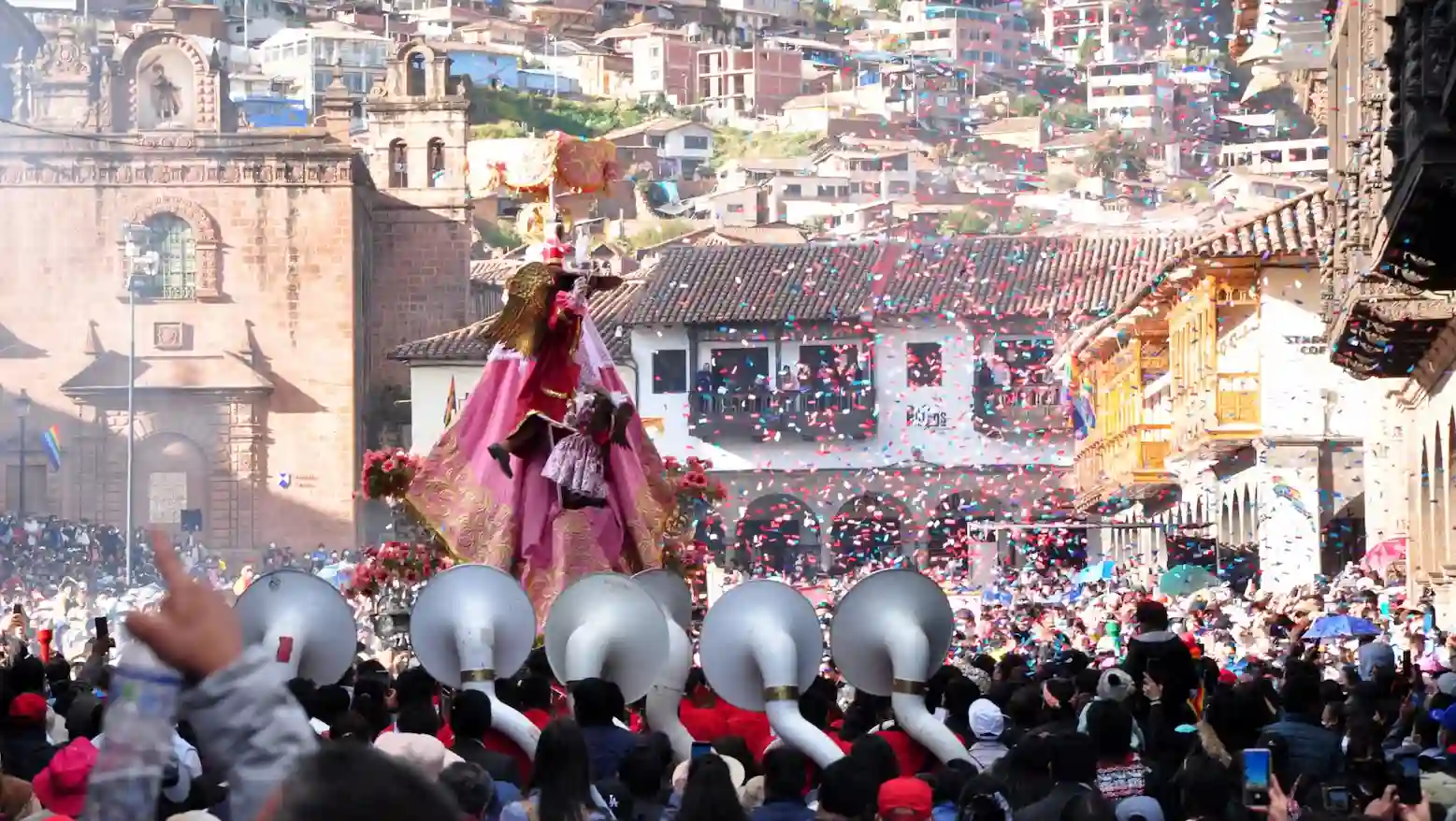
The festivities begin with the “Entrada de los Santos” (Entry of the Saints) on the Wednesday before the main day. During this powerful and highly anticipated event, fifteen saints and virgins are carried in large processions from their respective parishes, some located more than 8 miles (14 km) away, toward the Cusco Cathedral. Each group is accompanied by musicians, dancers, and devoted community members.
The following day, Thursday, marks the central celebration, featuring a solemn mass and a massive procession around the Plaza de Armas. This is the most crowded and visually impressive moment, attracting tens of thousands of attendees, including locals, pilgrims, and international visitors.
You might be interested: 40 Animals in the peruvian amazon

Where does it take place and why is it so important?
The heart of Corpus Christi in Cusco is the Plaza de Armas, the city’s main square and one of the most historically significant spaces in the Andes. During the Inca Empire, this plaza was known as Huacaypata, a ceremonial center where major rituals, celebrations, and gatherings took place. It was considered a sacred space long before the arrival of the Spanish.
When the Spanish colonized Cusco, they built colonial structures over Inca foundations, transforming the square into a symbol of both continuity and change. Today, Corpus Christi reflects this layered history, as ancient traditions and Catholic beliefs converge in the same physical and cultural space.
The Cusco Cathedral, constructed between 1560 and 1654 on top of what was once an Inca palace, becomes the focal point of the celebration. It houses the fifteen saints during the festival and serves as the spiritual center of all activities.
You might be interested: 15 Amazon pink dolphin facts
Corpus Christi in Cusco
If you are planning to visit Cusco in June, there is one event you simply cannot miss: Corpus Christi. This is one of the most important cultural and religious celebrations in Peru, where history, faith, gastronomy, and tradition come together in a unique way.
In this section you will learn everything you need to know about Corpus Christi in Cusco, including when it takes place, what to expect, how to experience it like a local, and practical tips to plan your trip with confidence.
The Entry of the Saints: the beginning of everything
For many locals, the most emotional and authentic moment of Corpus Christi takes place the day before the main celebration, during the Entrada de los Santos (Entry of the Saints).
On this Wednesday, the fifteen saints and virgins begin their journey from their respective parishes toward the Cusco Cathedral. These are not short or simple routes. In fact, some communities travel more than 14 km (over 8 miles) to reach the historic center, which transforms the entire city into a moving expression of devotion and celebration.
Each image is carried on large, elaborately decorated platforms and is accompanied by traditional brass bands that play continuously, groups of dancers performing cultural dances, and devoted families along with the mayordomos who organize the celebration.
As a result, the atmosphere becomes vibrant, emotional, and deeply communal. The streets fill with color, music, incense, and cheering crowds as each saint makes its entrance into the city.
One of the most anticipated highlights is the friendly competition between San Sebastián and San Jerónimo. Both saints come from districts in the southern part of Cusco, and their arrival is filled with energy and local pride, as each group tries to reach the Cathedral first. This moment reflects perfectly the blend of devotion and community identity that defines the festival.
The main day: procession, faith, and massive crowds
The day begins with a solemn mass in the morning, attended by clergy, local authorities, and hundreds of worshippers. Then, around midday, the main procession begins, which is the most visually impressive and crowded moment of the festival.
At the front of the procession, there is a silver float carrying the sacred Eucharist, also known as the custodia, which symbolizes the body of Christ. Following it, the fifteen saints move slowly around the Plaza de Armas, carried by teams of devoted participants.
During this time, the historic center becomes completely packed. It is estimated that tens of thousands of people gather in and around the square, filling every available space.
Because of this, balconies, rooftops, restaurants, and hotels overlooking the plaza become highly desirable viewing points. Many of these spaces are reserved weeks or even months in advance, since they offer one of the best perspectives of the event.
The 15 saints of Corpus Christi
One of the most remarkable aspects of Corpus Christi in Cusco is the gathering of fifteen sacred images, each representing a different parish, district, or community.
These are not just religious statues. On the contrary, they are deeply symbolic figures with centuries of history, devotion, and cultural meaning. Each saint has its own group of followers, traditions, and responsibilities within the festival.
Among the most prominent are San Cristóbal, San Sebastián, San Jerónimo, San Francisco de Asís, Santa Bárbara, Virgen del Carmen, and Señor de los Temblores.
In addition, every image is carried on richly decorated platforms adorned with flowers, silver details, mirrors, and embroidered fabrics that shine under the Andean sun.
For local communities, participating in the procession, especially carrying the saint, is considered a great honor and a responsibility that is passed down from generation to generation.
You might be interested: 15 Places to visit in the Amazon Rainforest

Corpus Christi food: what to eat and why it matters
You cannot fully experience Corpus Christi in Cusco without trying its most iconic dish: chiriuchu. This traditional cold dish is only prepared during this celebration, which makes it a seasonal specialty that locals look forward to all year. Its name comes from Quechua and roughly means “spicy cold dish,” and it represents the cultural diversity of Peru on a single plate.
Chiriuchu combines ingredients from different ecological regions of the country:
- Guinea pig (cuy) from the Andes
- Chicken
- Cecina (cured meat from the jungle)
- Fresh cheese
- Corn tortilla
- Seaweed (from the coast)
- Rocoto pepper
Because of this mix, the dish symbolizes the historical integration of coastal, highland, and jungle cultures. It is not just food, but a reflection of Peru’s identity.
During Corpus Christi, you will find chiriuchu sold in stalls around the Plaza de Armas and in local markets such as San Pedro Market. Prices usually range from 15 to 25 soles (about $4 to $7 USD) depending on the portion and location.
Another essential drink is chicha de jora, a traditional fermented corn beverage that dates back to pre-Inca times. It is slightly sour, refreshing, and widely consumed during festivals.

Traditional music and dances during the Corpus Christi in cusco
Throughout the entire celebration, Cusco becomes a city filled with sound and movement.
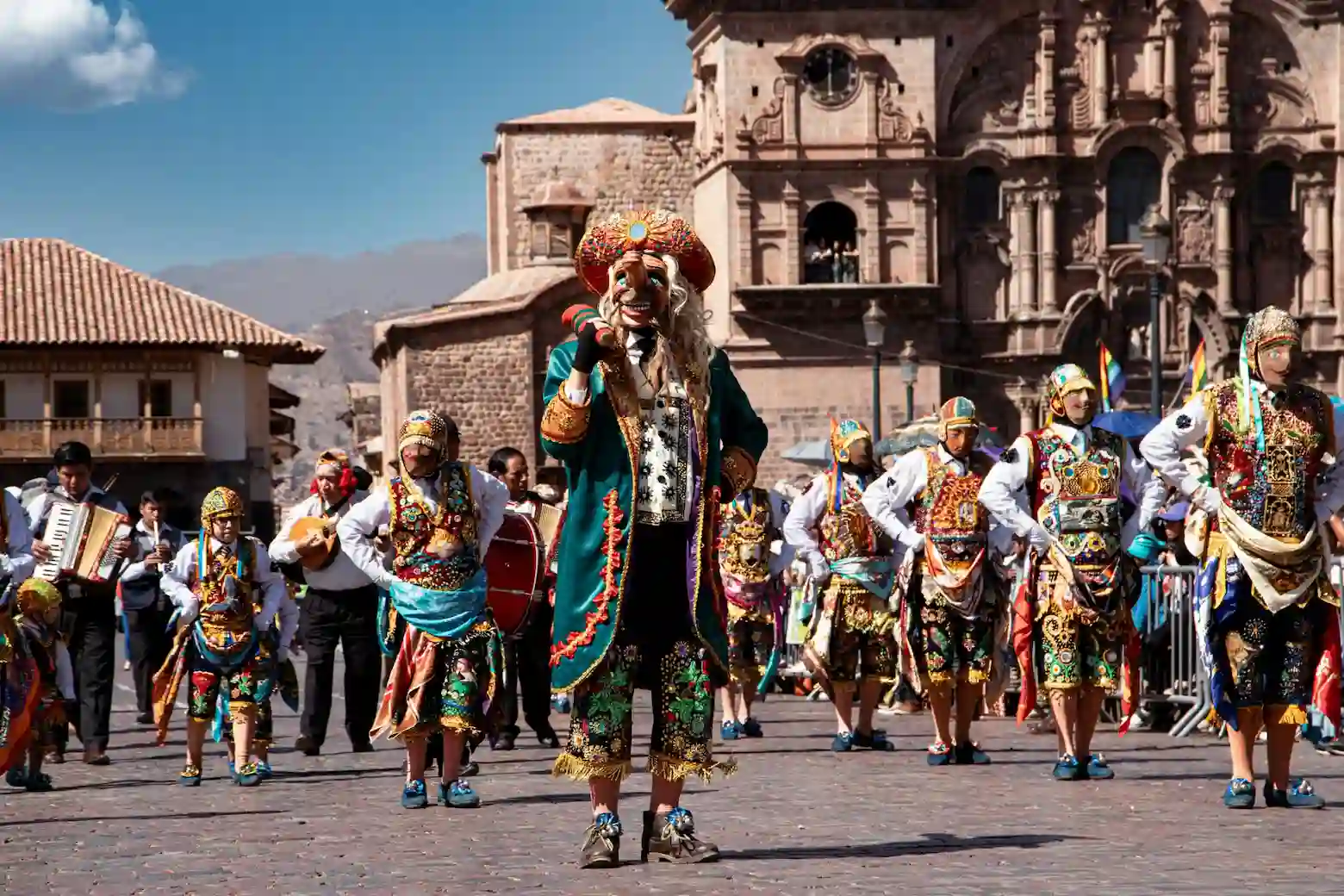
Each parish arrives with its own identity expressed through music and dance. You will constantly hear live brass bands, drums, and traditional melodies echoing through the streets.
Some of the most common dances you will see include:
- Qollas, representing highland traders
- Chunchus, inspired by Amazonian groups
- Morenadas, with colonial and Afro-Andean influences
These performances are not staged for tourists. Instead, they are part of living traditions passed down through generations. As you walk through the historic center, you will notice that music never stops. It blends religious hymns with Andean rhythms and festive sounds, creating a unique atmosphere that defines June in Cusco.
Practical travel tips for attending Corpus Christi in Cusco
If you are planning to attend Corpus Christi, preparation is key. June is one of the busiest and most exciting months in Cusco, but it also comes with challenges that travelers should be aware of.
Book early because prices increase significantly
June is peak tourist season in Cusco. This is not only due to Corpus Christi, but also because of major events like Inti Raymi (June 24).
Hotels in the historic center can sell out 1 to 2 months in advance
Prices can increase by 30% to 50% compared to low season
Mid-range hotels typically range from $60 to $120 USD per night, while higher-end options can exceed $200 USD
If you want a room with a balcony view of the Plaza de Armas during the main procession, you should book as early as possible, since these are the most requested spots.
Arrive early and understand the full schedule
Many travelers make the mistake of only attending the main Thursday. However, to truly experience Corpus Christi, you should plan to be in Cusco for at least 3 to 5 days.
- Wednesday: Entry of the Saints, one of the most authentic moments
- Thursday: Main procession, the most crowded day
- Following days: Cultural atmosphere continues with food, music, and gatherings
- Final day (Octava): Closing procession
Arriving early also allows you to explore the city without rushing and to secure good viewing spots.
Take altitude seriously
Cusco sits at 3,400 meters (11,150 feet) above sea level, which can affect many travelers.
To avoid altitude sickness:
- Arrive at least 1 or 2 days before the event
- Drink plenty of water
- Avoid alcohol during your first 24 hours
- Eat light meals
- Consider coca tea, which is widely available
Taking time to acclimate will make a big difference in how much you enjoy the festival.
Be prepared for June weather
June is part of the dry season in Cusco, which is considered the best time to visit in terms of weather. However, temperatures vary significantly throughout the day:
Daytime: Sunny and pleasant, around 65–70°F (18–21°C)
Nighttime and early morning: Cold, dropping to 39–41°F (4–5°C)
Because of this, it is important to dress in layers. Bring a warm jacket for mornings and evenings, sunscreen for the strong Andean sun, and comfortable walking shoes.
Get the best viewing spots
The Plaza de Armas becomes extremely crowded on the main day.
To get a good spot:
- Arrive at least 2 to 3 hours before the procession
- Stand near corners or side streets for slightly less crowded views
- Consider booking a restaurant or café with a balcony
Balcony access can cost anywhere from $20 to $60 USD per person, depending on the location and included services.

