
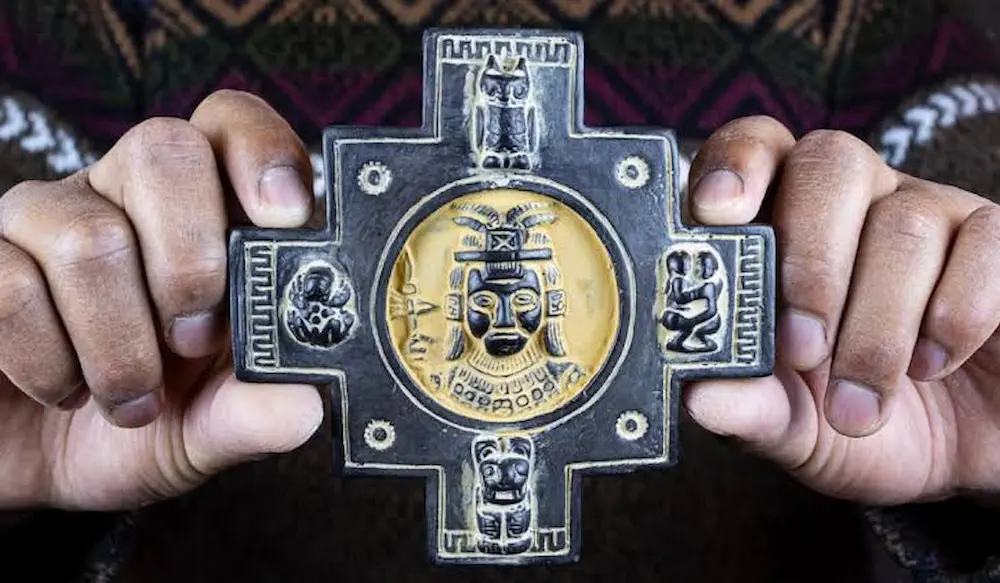
The Andes are home to ancient traditions, fascinating beliefs, and symbols that reflect the deep relationship between people, nature, and the universe. Among these cultural expressions, the Chakana stands out as one of the most recognizable representations of Andean thought. Also known as the Andean Cross, this stepped geometric figure carries meanings connected to balance, connection, spirituality, and the organization of the cosmos.
Understanding the chakana symbol meaning involves looking beyond its distinctive shape. Its structure is associated with different levels of existence, the relationship between the earthly and spiritual worlds, and the importance of harmony in everyday life. Moreover, the symbol appears in archaeological remains, traditional textiles, architecture, and contemporary Andean expressions.
For travelers interested in Peru’s cultural heritage, exploring the Chakana offers a valuable way to understand how ancient Andean communities interpreted their surroundings. Its significance also provides a closer look at the beliefs and traditions that continue to shape the cultural identity of the region.
What is the Chakana in Andean culture?
The Chakana is a stepped cross-shaped symbol associated with the cultural and spiritual traditions of the Andean region. Its name is commonly connected to the Quechua word chaka, meaning bridge, although the term has different interpretations depending on its linguistic and cultural context.
Unlike a simple geometric decoration, the Chakana is often understood as a representation of connection. Its stepped structure suggests the relationship between different spaces and dimensions of existence, while its central opening is commonly interpreted as a point of intersection.
The symbol is also known by several names:
- Andean Cross: A widely used name that describes its characteristic geometric shape.
- Inca Cross: A popular designation associated with its presence in Inca cultural heritage.
- Stepped Cross: A reference to the staircase-like edges that distinguish its design.
- Chakana: Its original name, commonly used when discussing Andean cosmology and ancestral traditions.
Although the Chakana is frequently associated with the Inca civilization, similar stepped geometric designs have been identified in artistic and archaeological expressions from earlier Andean societies. Therefore, its history should be understood within a broader regional context rather than attributed exclusively to the Incas.
What does the Chakana look like?
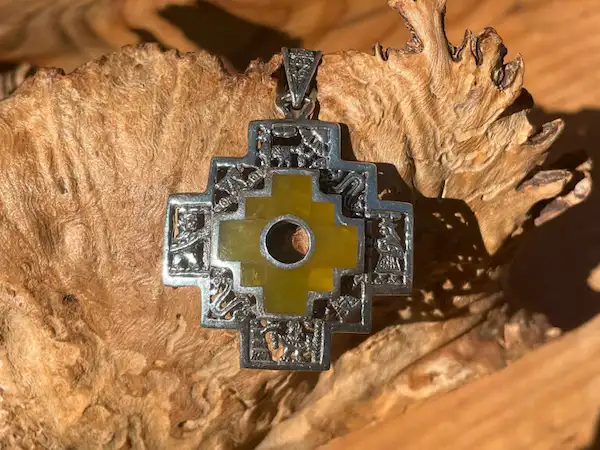
The traditional Chakana is generally represented as a symmetrical cross with four stepped arms and a central opening. Its geometric design combines straight lines, right angles, and different levels that create a distinctive visual pattern.
Each part contributes to the symbol’s interpretation:
- Four arms: Commonly associated with the organization of space and the four cardinal directions.
- Stepped edges: Often interpreted through the relationship between different levels or dimensions of existence.
- Central opening: Frequently associated with the point where different parts of the cosmos meet.
- Geometric symmetry: Reflects interpretations of balance, correspondence, and complementarity.
However, its design can vary across artistic representations, cultural traditions, and historical periods. As a result, not every Chakana includes exactly the same decorative elements or symbolic details.
Chakana symbol meaning and its connection to Andean cosmology
One of the most important interpretations of the Chakana comes from its relationship with Andean cosmology. This worldview considers existence as a network of relationships involving human beings, nature, spiritual forces, and the surrounding environment.
Rather than separating these elements into independent categories, Andean thought emphasizes their interaction and mutual dependence. Consequently, the Chakana is often interpreted as a visual representation of these connections.
Its structure is commonly associated with three dimensions of existence known as Hanan Pacha, Kay Pacha, and Uku Pacha. These concepts offer a way to understand how the universe was traditionally organized in several Andean interpretations.
Hanan Pacha: The upper world
Hanan Pacha refers to the upper world, a dimension associated with the sky, celestial bodies, and spiritual forces. It represents the space beyond everyday human experience and is connected with elements that influence life from above.
Within Andean traditions, the sky played an important role in understanding natural cycles. The movement of the Sun, the appearance of stars, and seasonal changes helped communities organize agricultural activities and interpret their surroundings.
Some of the elements associated with Hanan Pacha include:
- The Sun and its importance in agricultural cycles.
- Stars and constellations used as celestial references.
- Spiritual forces connected with the upper world.
- Natural cycles observed through the movement of celestial bodies.
Kay Pacha: The world of the living
Kay Pacha represents the earthly world, where human beings, animals, plants, and other living elements coexist. It is the dimension of everyday life and the environment in which communities develop their activities.
This world is particularly important because it reflects the direct relationship between people and their surroundings. Farming, community work, traditional celebrations, and the use of natural resources are all part of the experiences connected with earthly existence.
For Andean communities, maintaining harmony within this dimension involved respecting nature and recognizing the importance of collective life.
Uku Pacha: The inner or lower world
Uku Pacha is commonly interpreted as the inner or lower world. It is associated with the depths of the Earth, the ancestral realm, and the processes of transformation connected with life and death.
In several Andean interpretations, this dimension is also linked to the origins of life, fertility, and the natural processes that take place beneath the Earth’s surface.
It is important to understand that these three dimensions are not necessarily separate places. Instead, they form part of an interconnected worldview in which each dimension has a relationship with the others.
The three worlds of Andean cosmology:
| Dimension | General meaning | Main associations |
|---|---|---|
| Hanan Pacha | Upper world | Sky, stars, and spiritual forces |
| Kay Pacha | Earthly world | Human life, animals, and nature |
| Uku Pacha | Inner or lower world | Ancestral realm, Earth, and transformation |
What do the four directions of the Chakana represent?
Another important aspect of the Chakana is its four-sided structure. Its arms are frequently associated with the cardinal directions: north, south, east, and west.
These directions provide a way to understand the organization of geographical space and its relationship with the natural environment. In Andean cultures, orientation was important for observing the landscape, identifying agricultural areas, and recognizing the movement of celestial bodies.
Furthermore, the four directions can be interpreted through the organization of the Andean world and the historical importance of the four regions of the Inca Empire.
The relationship between the Chakana and the four suyus
The Inca Empire, known as Tawantinsuyu, was organized into four major regions connected to Cusco, its political and administrative center.
The name Tawantinsuyu is generally translated as the union of four regions or parts. These were:
- Chinchaysuyu: Located toward the northwestern part of the empire.
- Antisuyu: Associated with the eastern territories and the Andean-Amazonian region.
- Collasuyu: Extended toward the southeastern areas of the empire.
- Contisuyu: Located toward the southwestern part of Cusco.
This territorial organization demonstrates the importance of geographical orientation within the Inca world. Although the four directions are frequently connected with the Chakana in modern interpretations, they should not be treated as a universally established explanation for every version of the symbol.
Cusco played an important role in the organization of the Inca Empire and remains one of the best places to explore its historical and cultural heritage. Visitors interested in learning more about this legacy can also explore the different Cusco day tours available, which offer opportunities to visit historical sites and discover the traditions that shaped the Andean world.
The spiritual meaning of the Chakana and its connection to nature
The chakana symbol meaning also involves a spiritual understanding of the natural world. In Andean traditions, nature was not simply a collection of resources available for human use. Mountains, rivers, land, and celestial elements held cultural and spiritual significance.
This relationship is particularly visible through the concept of Pachamama, commonly understood as Mother Earth. Pachamama represents fertility, nourishment, and the natural forces that sustain life.
For many Andean communities, expressing gratitude toward the Earth and respecting its cycles were essential parts of their relationship with the environment.
Pachamama and the importance of reciprocity
One principle frequently associated with Andean traditions is ayni, a form of reciprocity based on mutual support and exchange. It reflects the idea that individuals and communities participate in relationships where giving and receiving help maintain social and environmental balance.
This principle can be observed in different aspects of traditional life:
- Agriculture: Communities recognize the importance of the land and natural cycles for producing food.
- Community work: People cooperate to complete activities that benefit the entire group.
- Offerings: Ceremonial practices express gratitude and respect toward Pachamama.
Traditional knowledge: Cultural practices are transmitted between generations to preserve relationships with the environment. Therefore, the Chakana is often interpreted as a symbol that brings together these ideas of connection, balance, and reciprocity.
This close relationship between people and nature is also present in the Peruvian Amazon, where local communities have developed traditional knowledge about the forest and its natural resources. Travelers interested in experiencing this environment can visit the region through a Tambopata tour from Cusco, an experience that includes exploring the rainforest, observing wildlife, and learning about the natural surroundings of Lake Sandoval.
The connection between the earth and the sky
The Andean landscape also reveals the importance of observing the relationship between the Earth and the sky. Mountains, valleys, rivers, and celestial bodies formed part of the environment through which ancient communities understood time and space.
Astronomical observations helped identify seasonal changes, particularly those related to planting and harvesting. In this context, the Southern Cross constellation is frequently associated with interpretations of the Chakana.
The relationship between celestial observations and agricultural knowledge shows how astronomy, spirituality, and everyday activities were connected in Andean societies.
The relationship between the Andes and the Amazon can also be appreciated through the landscapes surrounding Cusco. Traveling from the highlands toward the rainforest reveals different ecosystems and the traditional knowledge of the communities that inhabit them. This experience can be explored through a Manu National Park tour from Cusco, which connects Andean landscapes with the biodiversity of the Amazon rainforest.
The origins and historical significance of the Chakana
The history of the Chakana is closely connected with the artistic, architectural, and spiritual expressions of different Andean societies. However, identifying its exact origin and establishing a single date for its appearance remain challenging.
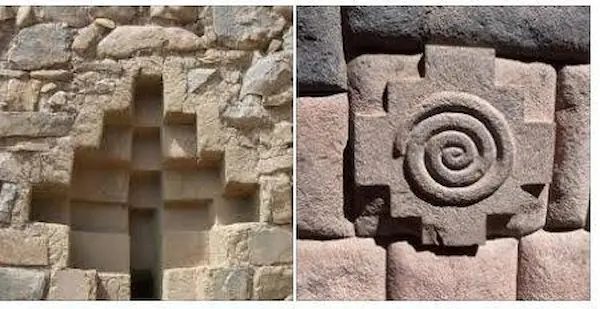
Archaeological evidence shows that stepped cross-shaped designs and related geometric patterns existed in the Andes before the expansion of the Inca Empire. They can be found in different forms of material culture, including stone carvings, ceramics, textiles, and architectural elements. These findings demonstrate that the symbol’s visual language belongs to a much broader cultural history.
If you are interested in reading: Q’eswachaka Bridge: Inca Bridge Festival
The Chakana before the inca empire
Several pre-Inca societies developed sophisticated artistic traditions and used geometric patterns to decorate objects, buildings, and ceremonial spaces.
Examples of Andean cultures that produced distinctive geometric designs include:
- Chavín: Known for its monumental architecture, stone carvings, and complex religious imagery.
- Paracas: Recognized for its elaborate textiles and funerary traditions.
- Tiwanaku: Noted for its monumental stone architecture and decorative motifs.
- Wari: Associated with important developments in urban organization, textiles, and artistic production.
Some stepped patterns identified in these cultures resemble elements of the Chakana. Nevertheless, visual similarities alone do not prove that every example had exactly the same meaning or represented an identical symbol.
The Chakana during the inca period
During the Inca period, geometric designs formed part of the architectural and artistic expressions found throughout the empire. Stepped motifs appeared in stone structures, textiles, and other objects associated with Andean material culture.
The use of these designs reflects the importance of geometry and visual organization in Inca artistic traditions. Archaeological sites such as Ollantaytambo preserve examples of stepped forms incorporated into stone architecture. These details help researchers examine how geometric patterns were used in different spaces and historical contexts.
If you are interested in reading: Machu Picchu Architecture and Buildings
The Chakana and its relationship with the southern cross
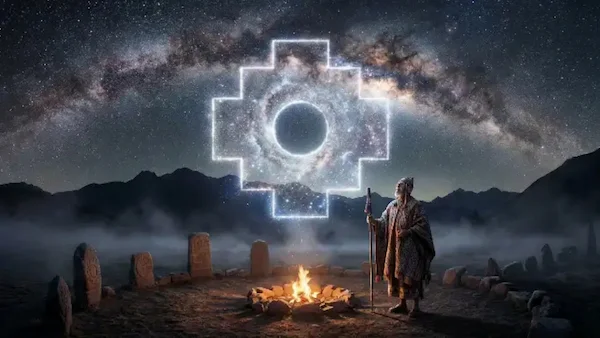
The Southern Cross, known as Crux, is one of the most recognizable constellations in the southern hemisphere. Its arrangement of bright stars has served as an important celestial reference for different cultures across the Southern Hemisphere.
In Andean interpretations, the constellation is frequently associated with the Chakana because of the resemblance between its star pattern and the stepped cross.
This connection also highlights the importance of astronomy in traditional Andean knowledge. Observing the sky allowed communities to identify seasonal changes and recognize patterns that were relevant to agricultural activities.
Why Was the Southern Cross Important to Andean Communities?
Celestial observation was an important part of understanding the natural environment. The appearance and position of certain stars provided references for interpreting seasonal cycles.
The Southern Cross was particularly significant because of its visibility in the southern sky. Its movement and orientation could be observed throughout the year, offering a reference for understanding changes in the celestial landscape.
Its cultural importance can be understood through several aspects:
- Astronomical observation: The constellation provided a recognizable reference in the night sky.
- Agricultural knowledge: Celestial observations contributed to the identification of seasonal patterns.
- Cultural symbolism: Its shape became associated with interpretations of the Chakana.
- Spiritual traditions: The relationship between the sky and earthly existence formed part of broader Andean beliefs.
However, the Chakana and the Southern Cross should not be considered identical in every interpretation. Their association is culturally significant, but the historical relationship between the geometric symbol and the constellation is more complex than a simple visual resemblance.
How the Chakana remains present in Andean traditions today
The Chakana continues to be recognized as an important cultural symbol throughout the Andes. Its presence in contemporary expressions reflects the value of ancestral knowledge and the efforts of different communities to preserve their cultural identity.
Today, its geometric design can be found in textiles, jewelry, handicrafts, artwork, and decorative objects. It is also used in educational and cultural activities that introduce younger generations to Andean traditions.
Nevertheless, its meaning can change depending on the community, the context, and the person interpreting it. For this reason, understanding the Chakana requires respecting the diversity of Andean cultural expressions.
The Chakana in traditional art and handicrafts
Traditional Andean craftsmanship provides an important way to observe how ancestral geometric patterns remain present in contemporary life. Artisans incorporate stepped designs and other symbolic elements into different handmade objects, connecting traditional visual expressions with modern artistic practices.
Some common examples include:
- Textiles: Geometric patterns incorporated into woven fabrics, garments, and decorative pieces.
- Jewelry: Necklaces, pendants, earrings, and bracelets inspired by the Andean Cross.
- Ceramics: Decorative designs that incorporate geometric forms and ancestral motifs.
- Wood and stone carvings: Handmade objects that reproduce stepped patterns and other traditional designs.
These objects are more than decorative souvenirs. They can also represent cultural memory, artistic knowledge, and the continuity of traditional craftsmanship.
The Chakana as a symbol of Andean cultural identity
For many people, the Chakana represents a connection with ancestral heritage and the knowledge transmitted across generations. Its continued presence in cultural activities, artistic expressions, and educational initiatives demonstrates the importance of preserving these traditions. Furthermore, the symbol offers visitors an opportunity to approach Andean culture through its own visual language.
When exploring traditional communities and archaeological sites in Peru, travelers may encounter geometric motifs that invite them to learn more about the history and beliefs of the region.
Discover the deeper meaning behind the Andean cross
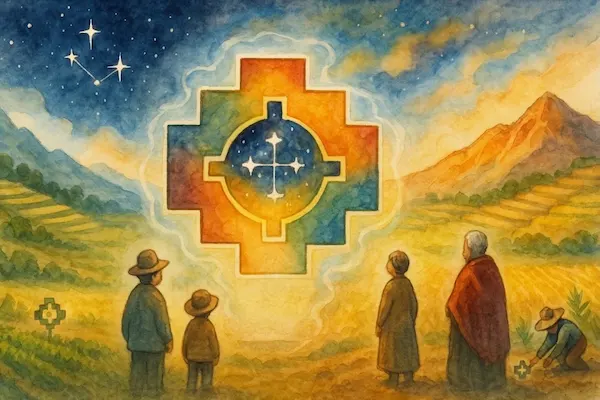
The Chakana is much more than a stepped geometric figure. Its cultural significance is connected with different interpretations of the universe, the relationship between human beings and nature, and the importance of balance within Andean traditions.
From the three dimensions of existence to the four directions and the connection with the Southern Cross, its symbolism offers a fascinating perspective on how ancient communities understood the world around them.
Although its interpretations vary across cultures and historical periods, the Chakana remains a meaningful expression of Andean heritage. Its presence in architecture, textiles, handicrafts, and contemporary cultural practices demonstrates how ancestral knowledge continues to inspire new generations.
For anyone interested in discovering Peru beyond its landscapes, learning about symbols such as the Chakana is an enriching way to appreciate the country’s cultural diversity and historical legacy. Understanding these traditions makes every journey through the Andes an opportunity to connect more deeply with the stories, beliefs, and communities that keep this heritage alive.

